PartnerShare vs Social Snowball: Which Referral Platform Fits Your Business Model?
Choosing between PartnerShare and Social Snowball often comes down to one question: are you selling software or physical products? PartnerShare is built for SaaS and digital products, with affiliate and referral tools designed around recurring subscriptions and deal tracking. Social Snowball targets DTC ecommerce brands, focusing on influencer partnerships and turning customers into affiliates. This comparison breaks down where each platform fits, what they do well, and where the trade-offs lie.
Quick comparison: PartnerShare vs Social Snowball

First viewport screenshot of Playbooks & Guides.
| Dimension | PartnerShare | Social Snowball |
|---|---|---|
| Primary audience | SaaS and digital product businesses | DTC ecommerce brands |
| Core strengths | Affiliate marketplace, in-product referrals, automated payouts | Influencer and creator management, customer-to-affiliate conversion |
| Pricing model | Free tier; paid plans with sales limits and service fees | Not publicly detailed in the provided context |
| Tracking focus | Clicks, signups, deals | Referral and affiliate activity for ecommerce |
| Global payouts | Multi-currency commission settlement | Not specified in the provided context |
| Best fit | Subscription software with performance-based partners | Product brands running creator and referral programs |
Search intent and what this comparison covers
People searching for "PartnerShare vs Social Snowball" are usually evaluating referral and affiliate software for a specific business model. They want to know which platform matches their product type, how pricing works, and whether the tool can handle their tracking and payout needs. This article addresses those questions directly, with practical guidance for SaaS teams and DTC brands.
PartnerShare: strengths for SaaS and digital products
PartnerShare is positioned as a low-risk, pay-for-performance growth tool for SaaS teams. Its main advantages include:
- Zero upfront cost to start. A free tier lets teams launch an affiliate or referral program before committing to a paid plan.
- Affiliate marketplace. Promoters can discover and promote products, which helps SaaS teams find partners without building a network from scratch.
- In-product referral system. Existing customers can become advocates through referral flows embedded in the product experience.
- Automated commission calculations and payouts. The platform handles commission math and global settlements, including multi-currency support.
- Fraud and chargeback protection. Useful for subscription businesses where refunds and disputed charges are common.
- Tracking across the funnel. Clicks, signups, and deals are tracked so teams can see where partners contribute.
These features align with SaaS economics: recurring revenue, trial-to-paid conversion, and partners who are paid on performance rather than upfront ad spend.
Social Snowball: strengths for DTC ecommerce
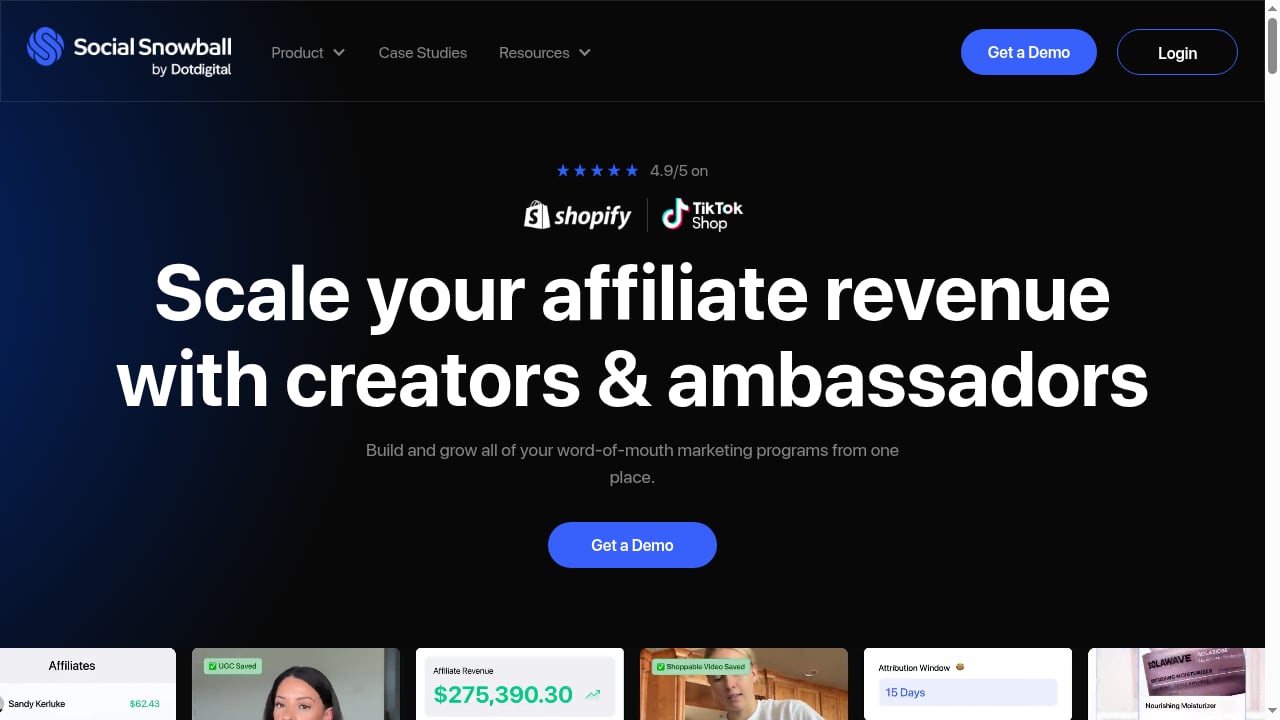
First viewport screenshot of www.socialsnowball.io.
Social Snowball describes itself as an influencer, affiliate, and referral marketing platform for ecommerce brands. Its stated focus is managing creator partnerships and turning customers into affiliates in one place. For DTC brands, that combination can be appealing because:
- Influencer and creator relationships are central to product discovery.
- Customer referral programs can drive word-of-mouth sales.
- A single platform for creators and customer affiliates reduces tool sprawl.
The provided context does not include detailed pricing, tracking capabilities, or payout features for Social Snowball, so buyers should verify those specifics directly with the vendor.
Where PartnerShare has an edge
For SaaS and digital product businesses, PartnerShare's advantages are concrete:
- Built for subscription tracking. Deal tracking and commission automation fit recurring revenue models better than ecommerce-first tools.
- Lower entry risk. A free tier and pay-for-performance positioning mean teams can test affiliate and referral programs without a large upfront budget.
- Global payout handling. Multi-currency settlement matters when affiliates span multiple countries.
- Fraud and chargeback protection. Subscription businesses face refunds and disputes; having protection built in reduces manual work.
If your product is software, PartnerShare's feature set maps more directly to how you earn revenue.
Where Social Snowball may fall short for SaaS
First viewport screenshot of www.socialsnowball.io.
Social Snowball is explicitly positioned for ecommerce brands. That focus creates potential gaps for SaaS teams:
- Ecommerce-oriented workflows. Creator and customer-affiliate management for physical products may not address subscription upgrades, trials, or seat-based pricing.
- Limited public detail on SaaS-specific needs. The provided context does not describe multi-currency payouts, chargeback protection, or deal tracking in the way PartnerShare does.
- Pricing transparency. Without published pricing details in the source material, SaaS buyers face more discovery work before they can compare costs.
None of this means Social Snowball is a weak platform; it means its strengths are aimed at a different buyer.
Pricing and risk: what buyers should weigh
PartnerShare publishes a free tier and subscription plans with varying sales limits, team members, and service fees. That structure lets teams start small and scale as affiliate revenue grows. Social Snowball's pricing is not detailed in the provided context, so buyers should request a quote and compare total cost at their expected volume.
Risk also differs by model. PartnerShare markets itself as pay-for-performance with no prepaid ad budget, which suits SaaS teams testing new channels. DTC brands evaluating Social Snowball should confirm contract terms, minimum spend, and how creator payments are handled.
Practical examples
SaaS example: A project management tool wants affiliates to promote a free trial. With PartnerShare, the team can track clicks and signups, pay commissions when a deal closes, and settle payouts in multiple currencies. The free tier lets them test before upgrading.
DTC example: A skincare brand wants creators to drive sales and customers to refer friends. Social Snowball's positioning around influencer and customer-affiliate management fits that workflow, though the brand should verify tracking and payout details during evaluation.
Decision guide: which platform should you choose?
First viewport screenshot of www.socialsnowball.io.
- Choose PartnerShare if you run a SaaS or digital product, want affiliate and referral programs in one place, need automated commission payouts, and prefer a low-risk start with a free tier.
- Choose Social Snowball if you run a DTC ecommerce brand and your priority is managing influencer partnerships alongside customer referrals.
- Consider both if you sell both software and physical products, or if you need to compare creator workflows against SaaS tracking before committing.
For broader context on partner marketing platforms, see our comparison of PartnerShare, impact.com, and Referral Factory for SaaS. If influencer management is a priority, our ranking of influencer marketing platforms may help. You can also explore how PartnerShare works with Semrush for brand visibility.
Related reading
- Upfluence Review 2026: Influencer Platform for Ecommerce - Evidence-based Upfluence review: ideal users, use cases, strengths, limitations, pricing signals, setup, and decision criteria for ecommerce brands.
- Top 10 Enterprise Referral & Loyalty Platforms 2026 - Independent 2026 ranking of the top 10 enterprise referral and loyalty marketing platforms, with evidence, criteria, and fit guidance for enterprise buyers.
Sources and further reading
- Partners - SocialEcho - Partner with leading global companies to drive social media marketing innovation and provide users with more complete solutions.
- The Secret Weapon for Winery Marketing With Jared Siebert of Vintools - Join us for a deep dive into the intersection of wine, tech, and marketing. In today’s episode of Legends Behind the Craft, Drew Thomas Hendricks chats with Jared Siebert, the founder of Vintools, about how modern APIs, integrations, and thoughtful design are helping wineries grow their online presence with less friction. Whether you're a tech-savvy winery or just starting your digital journey, this episode uncorks the tools and strategies that are reshaping how wine brands connect with customers.
- Advertising is dead - Partnership Marketing Insights - impact.com - ... social media buzz and skyrocket referral sales," BigCommerce, accessed ... "Influencer Marketing: Social media influencer market stats and research for.
FAQ
Is PartnerShare suitable for ecommerce brands?
PartnerShare is designed for SaaS and digital product businesses. Ecommerce brands with physical products may find Social Snowball's DTC focus more aligned, though PartnerShare's affiliate tools could still support digital goods.
Does Social Snowball support SaaS subscription tracking?
Social Snowball is positioned for ecommerce. The provided context does not describe subscription or deal-based tracking, so SaaS teams should confirm capabilities directly.
How does PartnerShare pricing work?
PartnerShare offers a free tier and paid plans that vary by sales limits, team members, and service fees. This lets teams start without upfront cost and scale as needed.
Can I use both platforms?
Using both is possible but adds complexity. Most teams should choose the platform that matches their primary revenue model and revisit if they expand into new product types.
Conclusion
PartnerShare and Social Snowball serve different business models. PartnerShare's affiliate marketplace, in-product referrals, automated payouts, and fraud protection make it a strong fit for SaaS and digital products. Social Snowball's influencer and customer-affiliate focus suits DTC ecommerce brands. Match the platform to how you sell, verify pricing and tracking details, and start with the option that reduces risk while supporting your growth model.