Aspire Review 2026: Influencer Platform Fit, Pricing & Limits
Aspire is an all-in-one influencer marketing platform built for ecommerce brands that want creator partnerships to behave less like one-off sponsorships and more like a repeatable sales channel. It combines a large creator marketplace, AI-assisted discovery, campaign management, and ROI reporting. This review breaks down where it fits, where it strains, and how to decide whether it belongs in your stack.
Quick verdict: Aspire is strongest for established ecommerce brands running ongoing creator programs across multiple channels. Smaller teams or brands testing influencer marketing for the first time may find the platform's breadth and likely pricing harder to justify than a lighter alternative.
What Aspire actually is
First viewport screenshot of www.aspire.io.
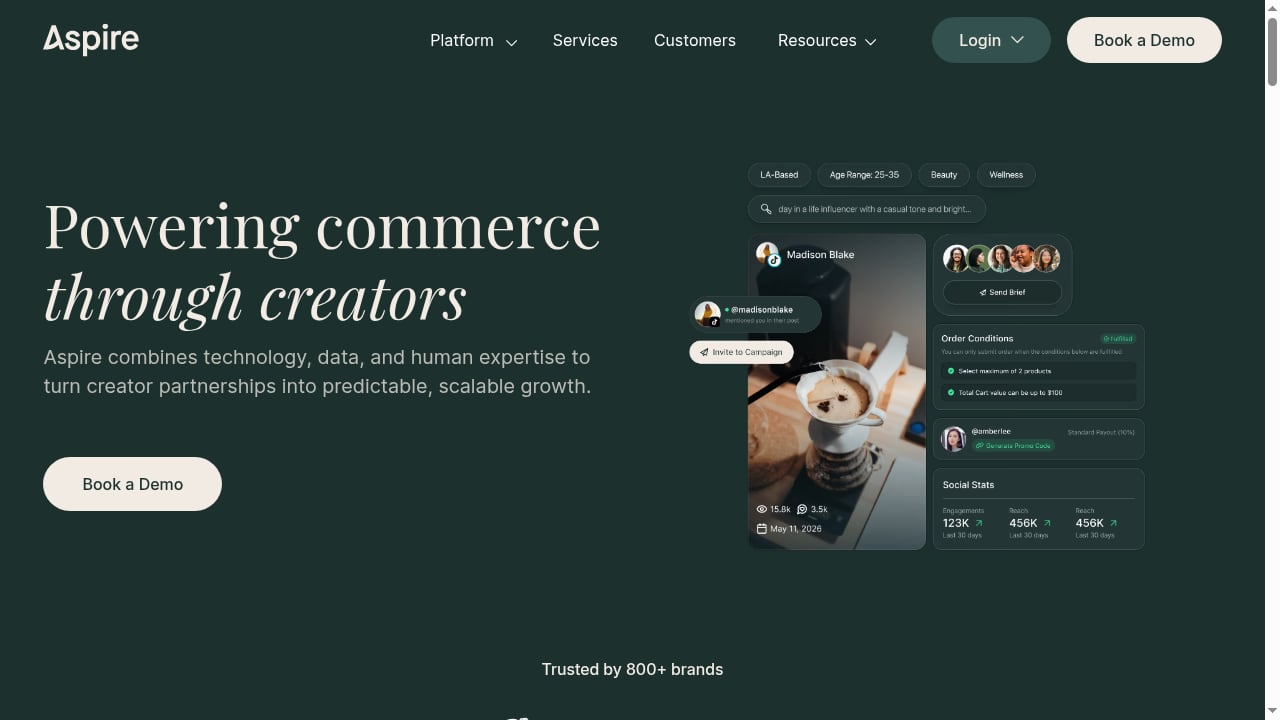
Aspire is not a single-purpose outreach tool. It is a platform for the full creator lifecycle: finding creators, negotiating and contracting, shipping product, approving content, tracking affiliate sales, and reporting results. The company positions itself as "the all-in-one creator platform" and says it is trusted by more than 800 brands.
Its core modules include:
- Aspire Marketplace — described as the world's largest marketplace for creators, used to source and shortlist partners.
- AI-powered creator discovery — plain-language search for creators instead of manual filter stacking.
- Contact Hub — a centralized place to manage creator communication and relationships.
- Personalized incentives — tailored agreements, commissions, and creator-specific terms.
- Campaign Manager — centralized tracking of campaigns, deliverables, and status.
- Content approval workflows — review and approve creator content before it goes live.
- Automated workflows — smart triggers for repetitive steps such as follow-ups and status changes.
- Analytics dashboards — attribution and performance reporting.
- Managed and agency services — optional human support for brands that want Aspire's team to run or assist with programs.
That scope is the main selling point and the main source of complexity. A brand that only needs to send 50 products to creators and track discount codes will be paying for a lot of infrastructure it may not use.
Who Aspire is built for
First viewport screenshot of www.aspire.io.
Aspire's product context points to ecommerce brands across home and garden, food and beverage, beauty, fashion, fitness, baby, and automotive. In practice, the platform fits brands with a few shared traits:
- You already run influencer campaigns regularly. Aspire makes more sense when creator marketing is a line item with a budget, not an experiment.
- You sell physical products. Gifting, sampling, affiliate codes, and content rights all assume a product that can be shipped and demonstrated.
- You want affiliate and influencer in one workflow. Aspire's incentive and commission features let you pay creators on performance, not just flat fees.
- You have someone to own the program. The platform automates steps, but someone still has to define the brief, approve content, and manage creator relationships.
Ideal use cases
- Always-on affiliate creator programs. Brands that recruit creators continuously and pay commissions on tracked sales.
- Product launch campaigns. Coordinating a wave of creators around a launch with content approval and deadlines.
- Gifting at scale. Sourcing and managing large numbers of product-seeding relationships.
- Multi-channel creator content. Managing creators who post across Instagram, TikTok, and YouTube with different deliverables.
Poor-fit scenarios
- Pre-revenue or very early brands. The platform's breadth is hard to justify before you know your creator acquisition cost.
- B2B SaaS with no physical product. Gifting and affiliate commerce workflows add little value.
- Teams that only need outreach. If your bottleneck is sending emails, a dedicated outreach tool is cheaper.
- Brands with no program owner. Aspire will not run the strategy for you unless you buy managed services.
Strengths, with evidence
First viewport screenshot of www.aspire.io.
1. Discovery and marketplace depth
The Aspire Marketplace and AI-powered search reduce the time between "we need 20 fitness creators" and a shortlist. Plain-language discovery is a practical advantage over platforms that require exact filter combinations. The trade-off is that marketplace size does not guarantee fit; you still need to vet audience quality and brand alignment.
2. Campaign and relationship management in one place
Contact Hub and Campaign Manager address a real operational problem: creator communication scattered across email, DMs, and spreadsheets. Centralizing outreach, agreements, deliverables, and approvals reduces the chance that a creator falls through the cracks.
3. Affiliate and commission flexibility
Personalized incentives and tailored agreements let brands pay creators in ways that match the relationship — flat fee, commission, or a mix. This is useful for brands transitioning from paid posts to performance-based partnerships.
4. Reported outcomes across categories
Aspire's published case studies include:
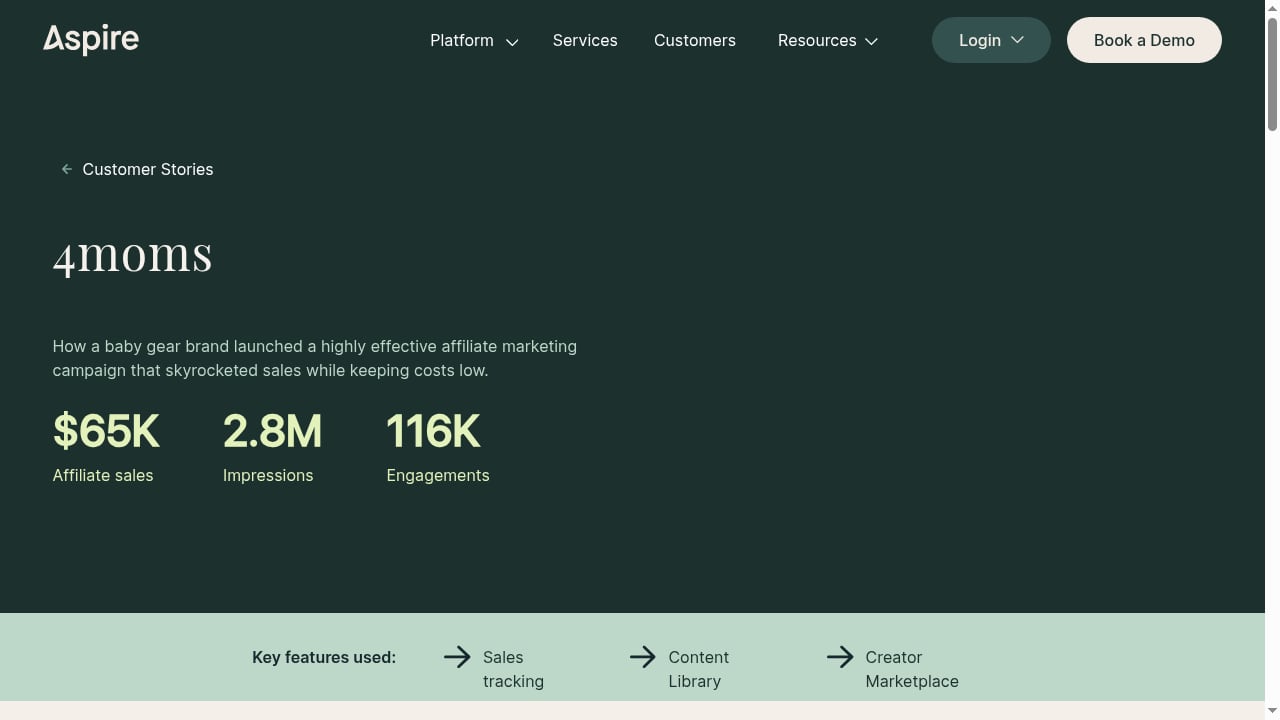
- 4moms generated $65K in affiliate sales and 2.8M impressions.
- AN Skin drove over $1M in sales with 5.7K conversions.
- Aura Frames attributed 20% of total sales to influencer marketing.
- Brands including Meyer, Graco, and Purdy & Figg reported substantial reach and revenue increases.
These are vendor-published results, so treat them as directional rather than guaranteed. They do show the platform can support programs at meaningful scale.
5. Human support options
Managed and agency services are a differentiator. Brands that lack in-house creator expertise can buy execution support rather than learning the platform cold.
Limitations and risks
Pricing is not transparent
Aspire does not publish standard pricing on its site. Expect enterprise-style, quote-based pricing that scales with your program size and feature needs. That makes budgeting harder and favors brands that can absorb a sales cycle. If transparent, self-serve pricing matters to you, compare options like Influencer Hero, which publishes entry pricing.
Breadth creates onboarding overhead
An all-in-one platform means more settings, more workflows, and more decisions. Expect a real setup period before the platform pays for itself. Brands without a dedicated operator often underuse the features they pay for.
Marketplace quality still needs human judgment
AI discovery speeds up sourcing but does not replace vetting. Audience authenticity, engagement quality, and brand safety still require review. Do not treat marketplace size as a proxy for creator quality.
Attribution depends on your tracking setup
Aspire's ROI reporting is only as good as the links, codes, and integrations you configure. Brands with messy discount-code practices or no affiliate tracking discipline will see noisy data.
Best-fit bias toward larger catalogs
Brands with small SKU counts and narrow audiences may find the creator marketplace less useful than brands with broad product lines and many gifting options.
Pricing signals
Because Aspire does not publish standard rates, the practical approach is to model cost against expected creator volume and affiliate revenue. Ask during evaluation:
- What is the base platform fee, and what triggers an increase?
- Are marketplace contacts included, or is outreach metered?
- How are affiliate commissions and payouts handled, and who pays transaction fees?
- Are managed or agency services included or priced separately?
- What is the contract length and cancellation policy?
As a rough signal, all-in-one influencer platforms with marketplace access and affiliate tooling typically sit in the mid-to-high monthly range for growing brands, with enterprise quotes above that. Treat any specific number as negotiable and tied to your program scope.
Setup: what to expect
A realistic Aspire rollout follows four phases:
- Account and integration setup. Connect your ecommerce platform, install tracking, and configure attribution. This is where most reporting quality is decided.
- Program design. Define creator tiers, commission structures, content rights, and approval rules. Decide what is standardized and what is negotiated per creator.
- Workflow configuration. Build automated triggers for outreach follow-ups, content approval, and status changes. Keep the first version simple.
- Pilot campaign. Run a small cohort of creators before scaling. Measure cost per acquisition, content output, and affiliate conversion before committing to a larger budget.
If you are comparing tracking reliability across tools, this breakdown of affiliate tracking software is a useful reference for what to test during setup.
Aspire vs alternatives: decision criteria
First viewport screenshot of www.aspire.io.
| Criterion | Aspire is a good fit when… | Consider an alternative when… |
|---|---|---|
| Program maturity | You run ongoing creator programs | You are testing influencer marketing for the first time |
| Product type | You sell physical products with gifting potential | You sell software or services |
| Budget | You can absorb quote-based pricing | You need transparent, low-entry pricing |
| Team | You have a dedicated program owner | No one can own the platform day to day |
| Reporting needs | You want affiliate and influencer data together | You only need basic outreach |
For brands comparing creator-focused tools, Influencer Hero vs PartnerShare vs Trackdesk covers tracking reliability and fit for creator campaigns. If your priority is affiliate network quality rather than creator management, see this ranking of affiliate marketing networks.
Related reading
- PartnerShare vs Rewardful vs Referral Factory: 2026 Comparison - Compare PartnerShare, Rewardful, and Referral Factory for SaaS affiliate and referral programs: pricing, tracking, payouts, and which fits your stage.
- PartnerShare vs PartnerStack: Best Fit for SaaS Affiliate Programs - Compare PartnerShare and PartnerStack for SaaS affiliate and referral programs. See pricing, features, and which platform fits your growth stage.
Sources and further reading
- Aspire Reviews: 713 User Ratings - Aspire reviews, contact info, rates & FAQ. Get the full story from fellow consumers' unbiased Aspire reviews.
- Read Customer Service Reviews of aspire.com - Trustpilot - Reviews shaping this summary ... Enjoying the experience. The only issue is not having an app. Instead you have to go through the website. I get email updates and ...
- Reviews - Aspire - July 2026
FAQ
Is Aspire legit?
Yes. Aspire is an established influencer marketing platform used by more than 800 brands, with published case studies from ecommerce companies. It is a software and services company, not a scam. The more useful question is whether its pricing and feature depth match your program stage.
Does Aspire have transparent pricing?
No standard pricing is published. Expect a sales conversation and a quote based on your program size and feature needs. Ask specifically what drives cost increases before signing.
What size brand is Aspire best for?
It fits best with growing to established ecommerce brands that already run creator programs and have someone to manage them. Very early brands and B2B companies are usually better served by lighter or more specialized tools.
Can Aspire track affiliate sales from creators?
Yes. Aspire supports personalized incentives, commissions, and analytics dashboards for attribution. Accuracy depends on how you configure tracking and discount codes during setup.
Does Aspire replace an affiliate network?
Not necessarily. Aspire is built around creator partnerships and influencer commerce. Brands with large traditional publisher affiliate programs may still need a dedicated affiliate network or tracking layer.
Conclusion
Aspire is a credible, full-stack influencer marketing platform for ecommerce brands that want creator discovery, campaign management, and affiliate tracking in one system. Its strengths are marketplace depth, workflow centralization, and flexible creator incentives, backed by case studies showing real revenue impact. Its main limitations are opaque pricing, onboarding overhead, and a feature set that can overwhelm brands without a dedicated program owner.
Choose Aspire if you run ongoing creator programs, sell physical products, and want influencer and affiliate workflows unified. Look elsewhere if you need transparent self-serve pricing, have no one to operate the platform, or are still validating whether influencer marketing works for your brand. Run a small pilot, measure cost per acquisition, and let the data — not the marketplace size — make the decision.