Influencer Hero Review 2026: AI Outreach, Pricing & Who It Fits
Influencer Hero is an all-in-one, AI-assisted influencer marketing platform built for brands and agencies that run repeatable creator programs rather than one-off sponsorships. This review weighs what the platform does well, where it falls short, what the pricing actually signals, and which teams should shortlist it in 2026.
What Influencer Hero does
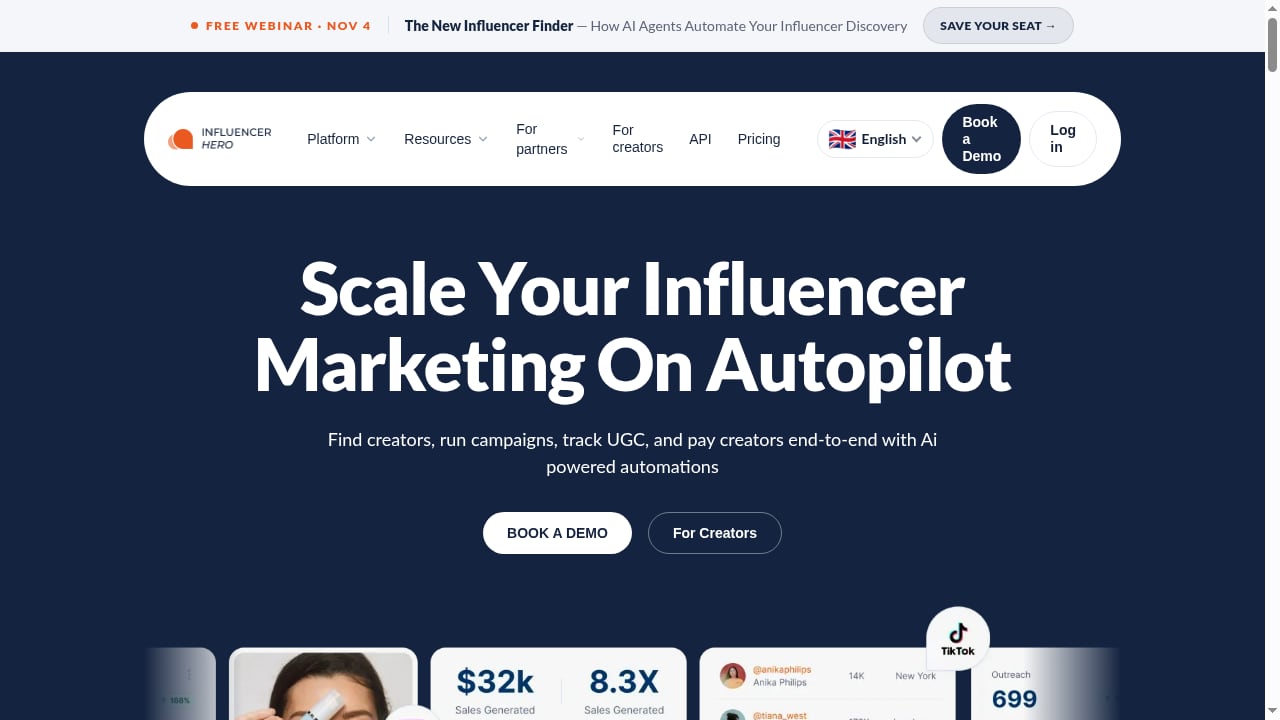
First viewport screenshot of www.influencer-hero.com.
At its core, Influencer Hero bundles four jobs that are usually split across separate tools:
- Discovery: AI-powered search across micro, macro, and nano creators with filters for keywords, location, follower count, engagement, and brand affinity.
- Outreach: Personalized bulk email campaigns, including AI-generated personalization lines intended to lift reply rates.
- CRM and campaign management: Pipelines, statuses, notes, and reporting for every creator relationship.
- Commerce and payouts: Shopify order creation for gifting, affiliate discount codes, UGC capture, and end-to-end creator payments.
The vendor reports adoption by more than 1,200 brands and 100 agencies, and the platform is also distributed as a Shopify app, which matters for ecommerce teams that want gifting and affiliate workflows inside their store admin.
Who Influencer Hero is built for
First viewport screenshot of www.influencer-hero.com.
Strong fit
- Ecommerce brands running gifting at volume. The Shopify integration turns an approved creator into a fulfillment order without manual re-entry, and AI email parsing pulls shipping details out of reply threads.
- Agencies managing multiple brands. Multi-brand dashboards and shared pipelines are a recurring theme in user feedback.
- Teams graduating from spreadsheets and DMs. If outreach currently lives in Instagram inboxes and a Google Sheet, the centralization alone is a meaningful upgrade.
- Programs with real volume. The entry price only makes sense if you are contacting dozens to hundreds of creators per month.
Weaker fit
- Solo founders testing influencer marketing for the first time. A $454/month entry point is hard to justify before you know your creator ROI.
- Teams that mainly need affiliate tracking rather than creator sourcing. A dedicated affiliate platform may be leaner and cheaper; see our comparison of PartnerShare vs Influencer Hero vs Trackdesk for that decision.
- Enterprise procurement with strict data-residency or custom-contract requirements. The plans are productized, and API access sits behind the Business tier.
Strengths, based on user evidence
1. Centralization is the real product
The most consistent praise across Shopify App Store and G2 reviews is not any single feature but the consolidation of discovery, outreach, tracking, and reporting in one dashboard. One reviewer described the platform as improving both efficiency and organization while keeping campaign management structured; another said the dashboard was far more effective than relying on DMs or TikTok Shop affiliate workflows.
2. Shopify-native gifting and affiliate workflows
Reviewers repeatedly highlight the ability to create influencer orders and affiliate discounts inside Influencer Hero and have them sync to Shopify. One merchant noted that AI parsing of email threads to capture shipping information removed most of the manual back-and-forth between collaboration approval and fulfillment.
3. Lookalike discovery and automatic UGC capture
A long-term user on Reddit singled out lookalike influencer search, direct Shopify order creation, and automatic content capture as the features that made the tool worth the price. For brands whose bottleneck is finding more creators like the ones that worked, this is the highest-leverage capability.
4. Support quality
Support is mentioned favorably far more often than is typical for software in this category, including named account reps and fast onboarding. That matters for agencies onboarding new brand accounts on a deadline.
Limitations and risks
Price relative to volume
The most common criticism is cost. The same Reddit reviewer called it "a bit pricey" while still recommending it for companies serious about outreach volume. The math is simple: divide the monthly fee by the number of creators you realistically contact per month. Below a few dozen, the per-creator cost gets uncomfortable.
Import and export friction
A one-star Shopify review cited difficulty importing an existing creator list and limited export options, and the merchant switched to Upfluence. The vendor's public reply points to CSV upload, Google Sheets, Zapier, and API as import paths, but the complaint is a useful warning: validate your data migration before committing to an annual term.
Learning curve and workflow lock-in
Several features — AI personalization, email parsing, affiliate code creation — assume you adopt the platform's workflow rather than layering it on top of an existing stack. Teams with an established CRM or outreach tool should map the overlap before buying.
Review volume is modest
Ratings are strong (4.8 overall on the Shopify App Store across roughly 60 reviews, with the large majority at five stars), but the sample is small and skews toward ecommerce merchants. Treat it as directional rather than definitive.
Pricing signals
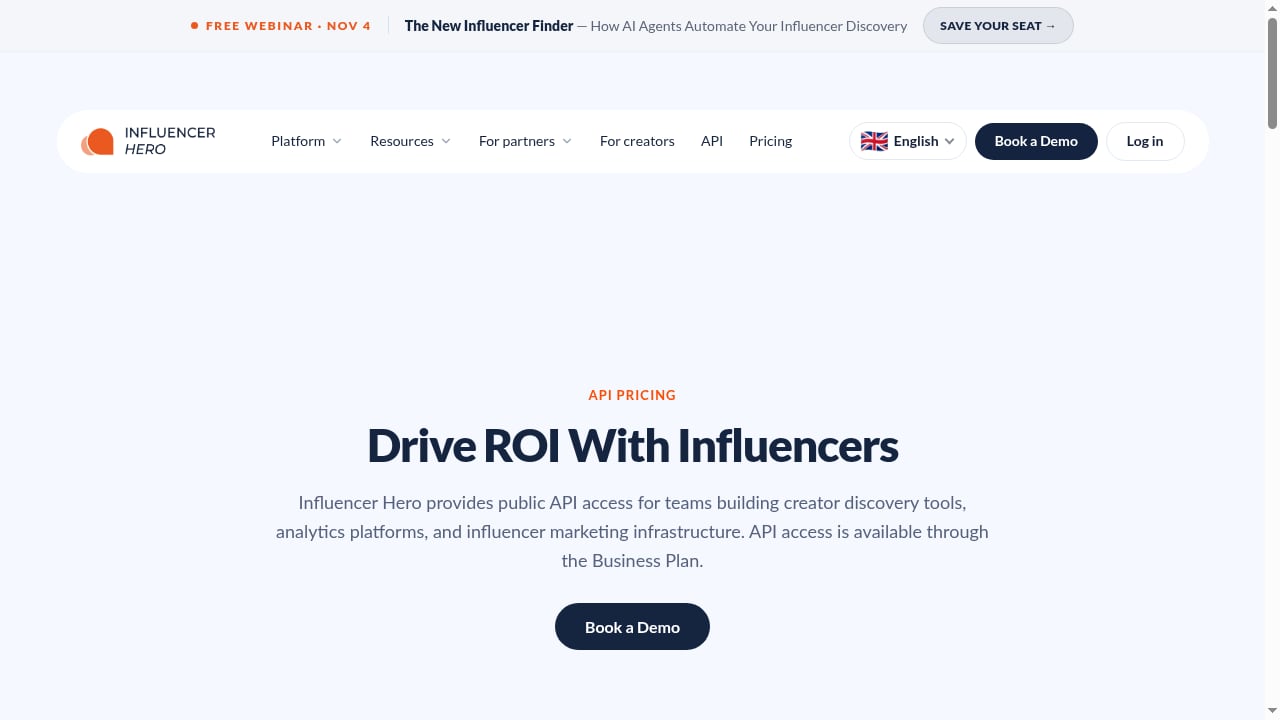
First viewport screenshot of www.influencer-hero.com.
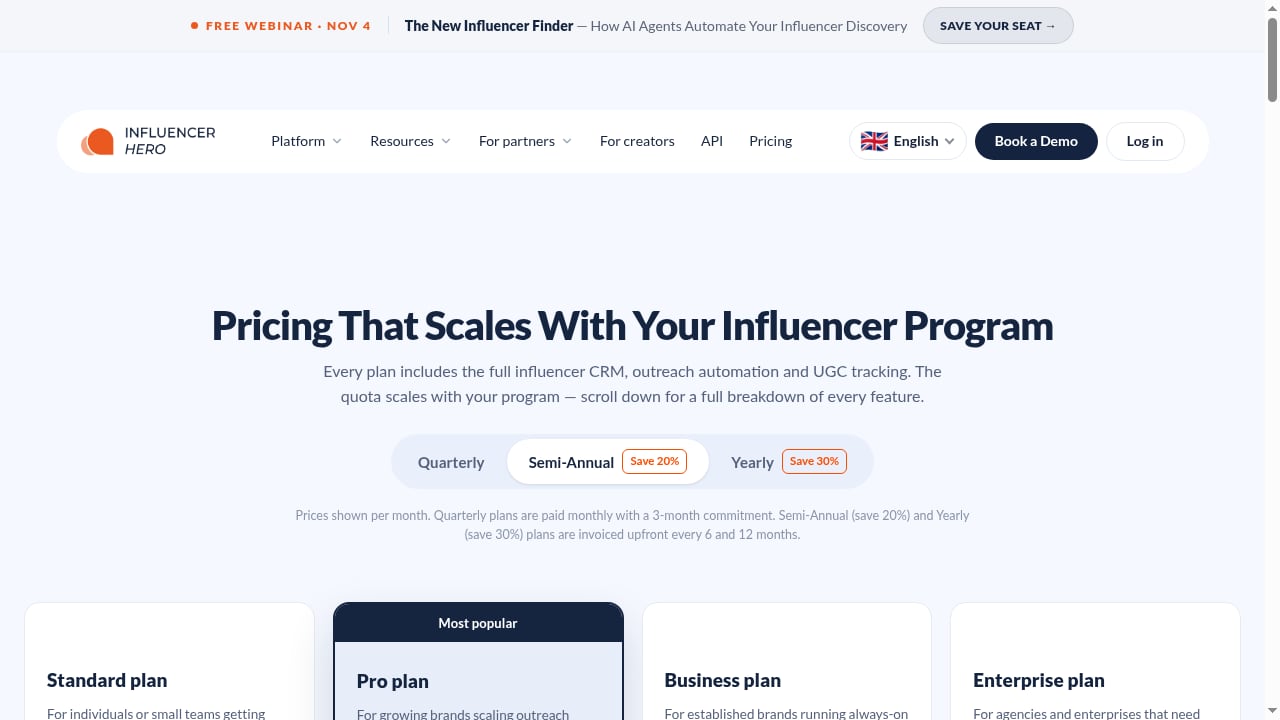
Influencer Hero's Standard plan starts at $454 per month billed yearly. Quarterly, semi-annual, and yearly billing are available, with savings of up to 30% for longer commitments. Every plan includes the full influencer CRM, outreach automation, and UGC tracking, with quotas scaling by tier. API access requires the Business plan, and additional influencer profiles, email checks, and reports are usage-based.
Two practical implications:
- The annual discount is where the value is. If you pay monthly, the effective cost per creator rises quickly.
- Model overage before you sign. Profile limits and email checks are the variables that turn a predictable subscription into a variable bill.
Setup: what to expect
A realistic first two weeks looks like this:
- Connect your store and email domain. Shopify connection enables gifting orders and affiliate codes; a warmed sending domain protects deliverability for bulk outreach.
- Import your existing creator list. Use CSV or Google Sheets, and reconcile duplicates before your first campaign.
- Define your filters and saved searches. Build lookalike searches from your best-performing creators rather than starting from broad keyword queries.
- Build one outreach sequence end to end. Test AI personalization on a small batch and measure reply rate before scaling.
- Set up gifting and affiliate flows. Confirm that orders and discount codes sync correctly to Shopify before a large send.
Reviewers consistently describe onboarding as fast and support-assisted, but the sequencing above is what prevents the import and deliverability problems that show up in negative reviews.
How it compares
First viewport screenshot of www.influencer-hero.com.
| Need | Influencer Hero | Typical alternative |
|---|---|---|
| Creator discovery plus outreach plus CRM | Strong, single platform | Often requires two or three tools |
| Shopify gifting and affiliate codes | Native | Manual or via integrations |
| Entry price | $454/mo billed yearly | Lower-cost point tools |
| Affiliate tracking depth | Adequate | Dedicated affiliate platforms |
| API access | Business plan | Varies |
If your priority is affiliate and referral tracking rather than creator sourcing, start with a broader look at affiliate tracking software. If you are weighing referral platforms for a SaaS product instead of a creator program, our PartnerShare vs Affiliatly breakdown covers that split.
Decision criteria: should you buy it?
Buy Influencer Hero if most of these are true:
- You contact at least several dozen creators per month.
- You sell on Shopify and want gifting and affiliate codes handled in one place.
- You manage more than one brand or client.
- You value support responsiveness and fast onboarding.
- You are willing to commit annually to capture the discount.
Look elsewhere if any of these apply:
- You need a low-cost way to test influencer marketing for the first time.
- Your existing CRM already handles creator relationships well.
- You require deep affiliate attribution rather than creator management.
- You cannot validate data import and export before signing.
Related reading
- Tolt Review 2026: AI Affiliate Software for SaaS Startups - Evidence-based Tolt review for SaaS startups: ideal users, use cases, strengths, limitations, pricing signals, Stripe/Paddle/Chargebee setup, and decision criteria.
FAQ
Is Influencer Hero worth the price?
For teams contacting dozens or hundreds of creators monthly, the consolidation of discovery, outreach, CRM, gifting, and payouts usually offsets the cost. For low-volume or experimental programs, the $454/month entry point is difficult to justify.
Does Influencer Hero integrate with Shopify?
Yes. Reviewers specifically praise creating influencer orders and affiliate discounts inside the platform that sync directly to Shopify, plus AI parsing of email threads to capture shipping details.
What do negative reviews say?
The main complaints are price and difficulty importing or exporting existing creator lists. The vendor points to CSV, Google Sheets, Zapier, and API as import options, so test your migration before committing.
Does it handle influencer payments?
Yes. The platform supports paying creators end to end, alongside UGC tracking and affiliate performance reporting.
Is there a free trial?
Pricing and trial terms change; confirm current offers directly with the vendor before budgeting.
Conclusion
Influencer Hero is a credible, well-reviewed platform for brands and agencies that treat influencer marketing as an operating system rather than a series of campaigns. Its differentiators are centralization, Shopify-native gifting, lookalike discovery, and responsive support. Its constraints are a high entry price, modest review volume, and import/export friction that deserves a test before you sign an annual contract. If you run volume and sell on Shopify, it belongs on your shortlist; if you are testing the channel or need deep affiliate attribution, start with a narrower tool.
Sources: Reddit discussion, Shopify App Store reviews, G2 reviews.