Top 10 Referral Marketing and Customer Advocacy Platforms 2026
Referral and advocacy budgets are under more scrutiny than ever, yet word of mouth remains one of the few channels that consistently lowers acquisition cost. The problem is rarely demand — it is tooling. A refer-a-friend widget that only tracks a checkout event cannot support a B2B reference program, a regulated-industry compliance review, or an enterprise advocacy motion that spans reviews, case studies, and ambassador communities.
This review ranks ten platforms that genuinely operate in the referral marketing and customer advocacy category. Each entry is scored against the same criteria, backed by publicly available evidence, and paired with the buyer profile it actually fits. Pricing signals reflect publicly available information as of early 2026; enterprise plans are usually custom-quoted.
How We Evaluated These Platforms
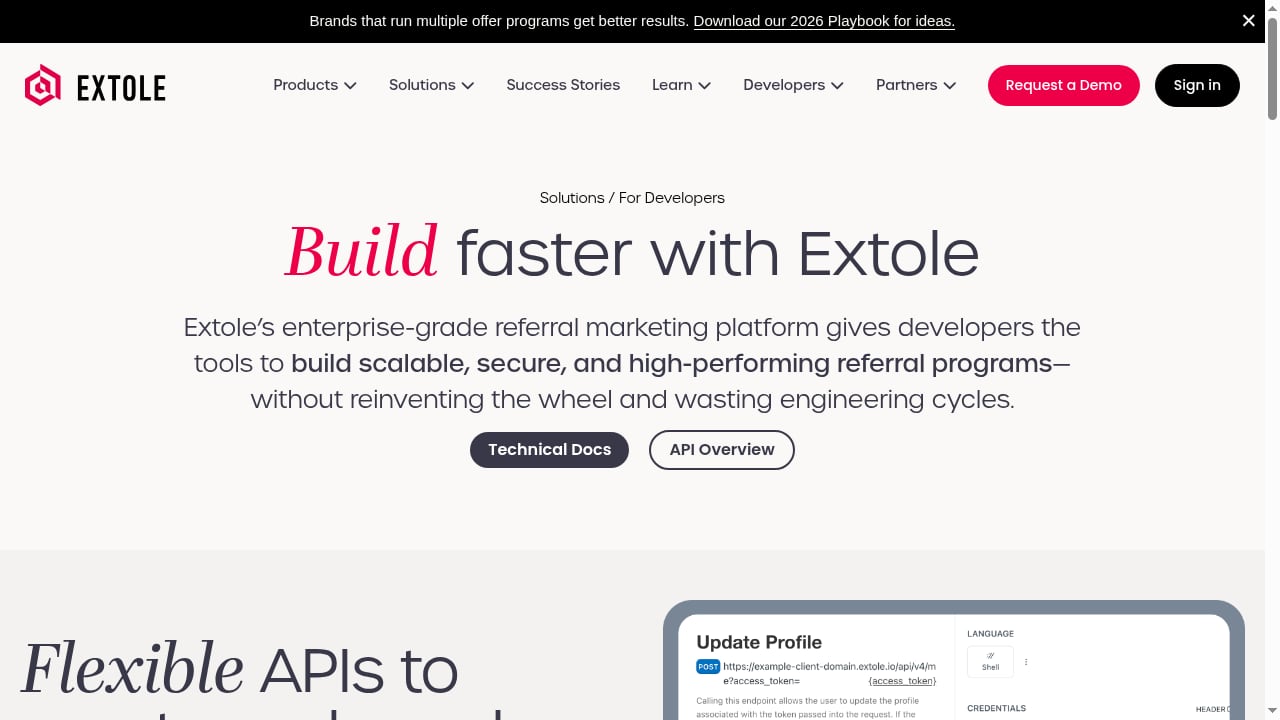
First viewport screenshot of Extole for Developers | Scalable APIs & SDKs for Referral Programs.
We scored every platform on five weighted dimensions:
- Program breadth (25%) — Does it support refer-a-friend, affiliate, influencer, ambassador, loyalty, or nomination programs, or only a single mechanic?
- Tracking and attribution depth (25%) — Can it follow a referral through a long B2B sales cycle, or does it stop at first purchase? Does it connect to CRM and CDP data?
- Fraud control and compliance (20%) — Self-referral detection, velocity limits, cooling-off periods, and eligibility rules for regulated industries.
- Integration and developer surface (15%) — Native CRM, ecommerce, and messaging integrations; documented APIs, SDKs, and webhooks.
- Time-to-value and pricing transparency (15%) — Self-serve launch options, implementation fees, and whether pricing is published.
We excluded tools that only offer a generic coupon or discount engine without referral or advocacy tracking. We also excluded affiliate-only platforms that do not support customer-led advocacy, since that is a different category with different economics.
The Top 10 Referral Marketing and Customer Advocacy Platforms for 2026
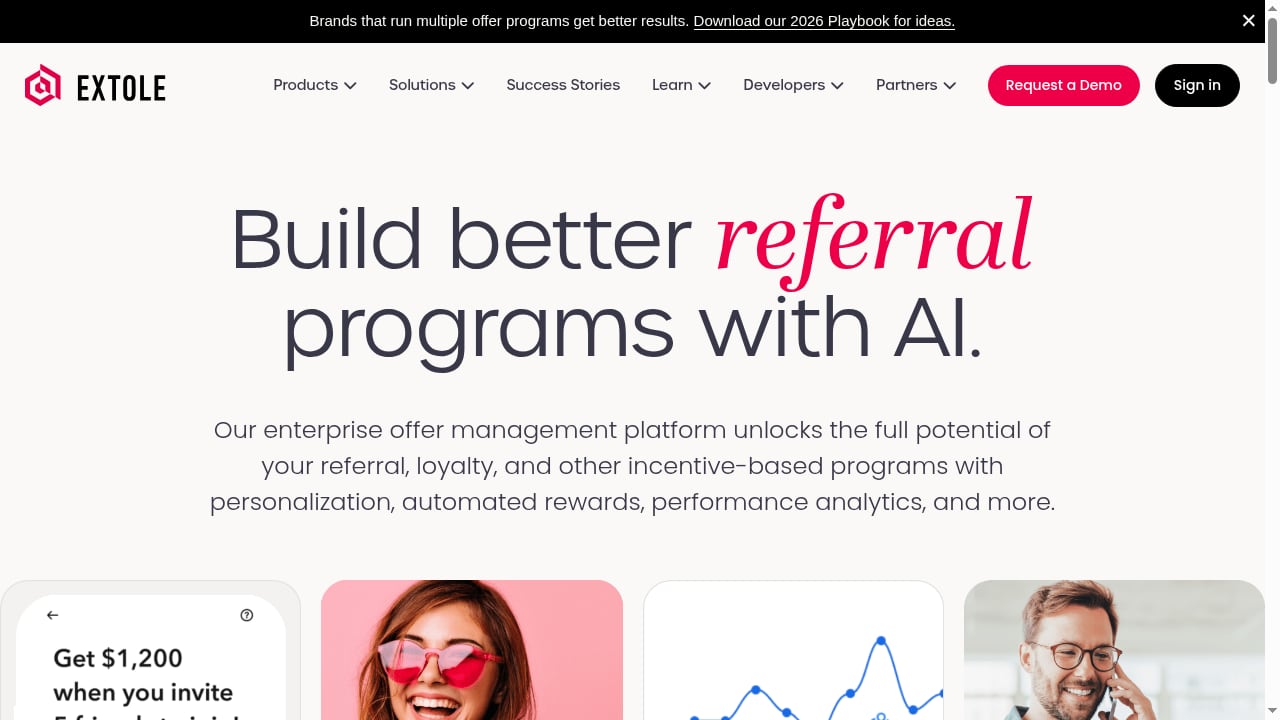
First viewport screenshot of Engagement and Referral Platform for Customer-led Growth | Extole.
1. Extole — Best for Enterprise Referral and Advocacy at Scale
Extole is built for consumer marketers and product teams running referral and advocacy programs with millions of touchpoints. It supports Refer-a-Friend, Influencer & Ambassador, Employee Ambassadors, Drop-a-Hint, Welcome Offer, Friends and Family, Loyalty, Nominations, and Sweepstakes programs from one platform.
Why it ranks first: Extole combines a no-code Flow Builder for program design with a full developer API and SDKs for headless or hybrid integrations. Its event-tracking architecture links referral activity to first-party customer data, so teams can fold referral into an existing CRM or CDP view rather than tracking it in isolation. The Reward Bank handles personalized redemption, and an MCP server supports AI-driven offer management — a meaningful differentiator as marketing teams adopt AI assistants for reporting.
Evidence and proof points: Extole is positioned for retail, financial services (banks, credit unions), telecoms, and B2B. It emphasizes security and compliance through JWTs, encryption, and API tokens, and publishes buyer's guides and best practices for credit unions, financial services, and B2B teams, plus a 2026 Referral Marketing Playbook.
Watch-outs: Custom quote only, and the platform is built for large programs — smaller brands may find it heavier than needed. Some users have reported CRM integration gaps.
Best for: Enterprise retail, financial services, and telecom brands that need referral tied to broader customer data and compliance requirements.
2. Mention Me — Best for Referral Intelligence and Benchmarking
Mention Me positions itself as a referral intelligence layer, benchmarked against a network of 500+ brands. Its Name Share mechanic captures organic, unincentivized referrals that discount-driven programs miss, and its performance data is available through AI assistants via MCP for read-only aggregate reporting.
Evidence: The company reports that clients typically acquire 10–15% of new customers via referral, with CAC running 30–50% lower than paid channels. It also cites 45,000+ A/B tests across 4,000+ programs.
Watch-outs: Not designed for small or early-stage brands, and pricing is not published.
Best for: Mid-market to enterprise brands that want their referral program measured against real benchmark data.
3. Talkable — Best for Ecommerce Referral Optimization and Fraud Control
Talkable is referral infrastructure for mid-market and enterprise ecommerce brands that treat referral as a performance channel rather than a set-and-forget widget. Its fraud detection has matured over a decade against self-referrals, coupon stacking, and duplicate accounts.
Evidence: Talkable reports over $110M in prevented fraud for clients and offers a strong A/B testing suite covering offers, segments, and placements. Dedicated customer success managers actively suggest tests.
Watch-outs: Custom pricing plus a one-month implementation fee; not built for early-stage brands still validating product-market fit.
Best for: Ecommerce brands that want heavy testing and fraud control at scale. For a deeper breakdown, see our Talkable review 2026.
4. Buyapowa — Best for Regulated Industries
Buyapowa is designed compliance-first, with support for cooling-off periods and eligibility rules that matter in telecom, insurance, and financial services. It is license-based with zero commission, which appeals to procurement teams that dislike revenue-share models.
Evidence: The platform is repeatedly cited as the compliance-first option for regulated referral programs, with integrations into Salesforce, HubSpot, SAP, and Workday.
Watch-outs: Enterprise-only, custom quote, and not a fit for small brands.
Best for: Regulated industries that need referral programs to pass legal and procurement review.
5. impact.com — Best for Unifying Affiliate, Influencer, and Referral Partners
impact.com is a partnership platform that unifies affiliate, influencer, and referral partner types under one system. For brands that have outgrown separate tools for each partner category, it consolidates tracking, contracts, and payouts.
Evidence: It integrates with Salesforce, Shopify, WooCommerce, and Adobe Commerce, with pricing signals from $30–$500+/month plus a 2.5% commission tax, and custom enterprise plans. See our full impact.com review 2026.
Watch-outs: The commission tax adds up at scale, and the platform is broad rather than deep in any single partner type.
Best for: Large enterprises that want one partnership platform across affiliate, influencer, and referral.
6. Referral Rock — Best for B2B and Non-Ecommerce Referrals
Referral Rock is a standalone referral, affiliate, and partner platform built for professional services, B2B, and non-Shopify brands. Its CRM-native sync with HubSpot and Salesforce tracks referrals through lifecycle and pipeline stages rather than a single checkout moment.
Evidence: It supports flexible reward structures including cash, credits, and gift cards, and offers a free tier for testing. Professional pricing starts around $200/month plus a $400 setup fee.
Watch-outs: The interface feels dated compared to newer platforms, and it is better suited to B2B sales cycles than checkout-based ecommerce.
Best for: B2B and professional services teams with longer sales cycles.
7. Yotpo — Best for Brands Already Using Yotpo Reviews
Yotpo bundles referral inside its broader Loyalty & Referrals product, so referral, points, VIP tiers, and reviews sit in one connected system. A customer's review history can shape their loyalty tier, and that tier can shape their referral offer, without exporting data between tools.
Evidence: It offers 20+ pre-built earning campaigns and native Shopify checkout integration for redemption. Pricing signals: free (no referral), Pro $199/month, Premium $799/month, custom enterprise.
Watch-outs: Pricing stacks quickly once Reviews and Loyalty are added, so referral alone costs more than a standalone tool.
Best for: Brands already using Yotpo for reviews or SMS that want referral in the same platform.
8. LoyaltyLion — Best for Shopify Loyalty-Led Referral
LoyaltyLion is a loyalty-first platform for Shopify and Shopify Plus brands where referral is one point-earning action among several. It triggers referral requests after specific moments, such as a purchase or a positive review, and nurtures top referrers with points and personalized thank-you communications.
Evidence: It integrates with Shopify POS, Klaviyo, and 50+ tools, with pricing from around $159/month.
Watch-outs: Referral is a feature of the loyalty engine, not a standalone referral platform — deep referral-specific testing is limited.
Best for: Shopify DTC brands that want referral inside a broader loyalty program.
9. Smile.io — Best for Small and Mid-Market Shopify Brands
Smile.io offers a free tier with referral built in, making it the fastest route to a live referral program on Shopify. It is designed for small to mid-market brands that want low-cost, self-serve setup.
Evidence: It integrates with Shopify, Klaviyo, and Gorgias, with pricing from free to $15–$999/month.
Watch-outs: Limited enterprise features, and referral depth is modest compared to dedicated platforms.
Best for: Small and mid-market Shopify brands that need something live today.
10. Annex Cloud — Best for Deep ERP and CRM Integration
Annex Cloud targets large enterprises that need referral and loyalty connected to complex back-office systems. Its connector library is the deepest in this list, spanning SAP, Oracle, and Salesforce.
Evidence: It offers 125+ enterprise connectors, with pricing signals from $50K–$250K+/year.
Watch-outs: The price point and implementation complexity put it out of reach for most mid-market teams.
Best for: Large enterprises with ERP and CRM systems that must stay in sync with referral and loyalty data.
How to Choose: A Quick Decision Framework
First viewport screenshot of Automate and Scale Incentives with BHN Rewards | Extole.
| If your priority is... | Start with... |
|---|---|
| Enterprise scale with compliance and first-party data | Extole, Buyapowa |
| Referral benchmarking against real market data | Mention Me |
| Ecommerce fraud control and A/B testing | Talkable |
| One platform for affiliate, influencer, and referral | impact.com |
| B2B pipeline-stage referral tracking | Referral Rock |
| Referral inside an existing reviews or loyalty suite | Yotpo, LoyaltyLion |
| Fast, low-cost Shopify launch | Smile.io |
| Deep ERP and CRM connectors | Annex Cloud |
A note on adjacent workflows: some teams run customer referral programs alongside external affiliate or promoter programs. Those are different categories with different economics. If your growth model depends on recruiting external promoters, a SaaS affiliate and referral platform such as PartnerShare can complement a customer advocacy platform — but it should not replace one. For a side-by-side look at how affiliate tracking differs from referral tracking, see PartnerShare vs Talkable vs Trackdesk: Affiliate Tracking.
Related reading
- How to Use PartnerShare with Voluum – Ad Tracker for Media Buyers - Connect PartnerShare with Voluum to track affiliate and media-buyer traffic in one place, cut discrepancies, and automate partner payouts.
Sources and further reading
- 10 Best Referral Marketing Software in 2026 - Best referral marketing software for 2026: compare 10 platforms on pricing, features, and fit, backed by data on what actually lowers CAC.
- Best customer advocacy platforms: Our top picks in 2026 - Customer advocacy platforms help you identify, activate, and mobilize loyal customers into brand advocates who drive referrals, reviews, and revenue growth. Here are our top picks.
- 11 Best Referral Marketing Software for B2C Brands (2026) - Compare the best referral marketing platforms for B2C brands, including tools for ecommerce, loyalty, and influencer referrals.
Frequently Asked Questions
What is the difference between referral marketing software and customer advocacy software?
Referral marketing software focuses on tracking and rewarding customer-driven introductions, usually with link management, reward fulfillment, and fraud control. Customer advocacy software is broader: it identifies advocates, manages asks such as reviews, references, and case studies, and measures advocacy impact on revenue. Many platforms in this list do both, but the depth varies.
Which platform is best for a B2B company with a long sales cycle?
Referral Rock is the strongest fit because it syncs natively with HubSpot and Salesforce and tracks referrals through pipeline stages rather than a single checkout event. Extole also supports B2B use cases, particularly when referral needs to connect to first-party data.
Do I need a separate affiliate platform if I already have a referral platform?
Often yes. Customer referral programs reward existing customers, while affiliate programs reward external promoters such as bloggers, creators, and review sites. Some platforms, like impact.com, unify both. Others, like PartnerShare, specialize in the affiliate and promoter side and can run alongside a customer advocacy platform.
How much should I expect to pay in 2026?
Entry points range from free (Smile.io, Referral Rock's limited tier) to roughly $159–$999/month for mid-market tools, with enterprise platforms like Annex Cloud quoted from $50K–$250K+/year. Enterprise referral platforms such as Extole, Mention Me, Talkable, and Buyapowa are custom-quoted.
What is the biggest mistake brands make when buying referral software?
Choosing a tool based on the widget rather than the data layer. If referral activity cannot connect to your CRM, CDP, or loyalty data, you cannot measure lifetime value, prevent fraud at scale, or personalize offers. Prioritize tracking architecture and integrations over the front-end experience.
Conclusion
The referral and advocacy category in 2026 splits into three tiers: enterprise platforms built for scale and compliance (Extole, Buyapowa, Annex Cloud), performance-focused ecommerce tools (Talkable, Mention Me, Yotpo, LoyaltyLion), and accessible entry points (Smile.io, Referral Rock). The right choice depends less on feature checklists and more on where your referral data needs to live — in a CRM, a CDP, a loyalty engine, or a standalone dashboard.
Start by mapping your program types, your tracking requirements, and your compliance constraints. Then match them against the platforms above. If your growth model also depends on external promoters, treat affiliate tooling as a separate decision — our Top 10 DTC influencer, affiliate, and referral platforms 2026 covers that adjacent landscape.