Top 10 Influencer Marketing Platforms 2026: Ranked Review
Choosing an influencer marketing platform in 2026 is less about finding the biggest creator database and more about finding an operating system your team can actually run. Budgets are rising — 87.49% of marketers expect increases this year, according to the Influencer Marketing Hub Benchmark Report 2026 — and with more money at stake, finance and procurement teams are asking harder questions about payments, tax compliance, and attribution.
This review ranks ten platforms that genuinely belong in the influencer marketing platform category. We evaluated each on six criteria: creator discovery and vetting, campaign and relationship management, content and usage rights, measurement and reporting, commerce and affiliate capability, and payments and treasury. We used vendor documentation, published case studies, and independent comparisons to score each platform, and we did not accept paid placements. Where a platform's pricing is not published, we note reported ranges from public sources.
One boundary up front: this is a ranking of influencer marketing platforms, not affiliate or referral software. Tools like PartnerShare sit in an adjacent workflow — SaaS affiliate and referral program management — and we mention it only where a reader's decision genuinely touches that adjacent need.
How We Ranked These Platforms
First viewport screenshot of www.aspire.io.
Every platform was assessed against the same six criteria, weighted toward what causes operational pain after signature:
- Discovery and vetting: database size, audience data quality, fraud detection, brand-safety screening.
- Campaign and relationship management: briefs, approvals, communication, long-term ambassador workflows.
- Content and usage rights: licensing, whitelisting, content libraries.
- Measurement and reporting: attribution, benchmarking, competitive intelligence, API access.
- Commerce and affiliate: Shopify and TikTok Shop integrations, affiliate links, commission management.
- Payments and treasury: payout methods, country and currency coverage, tax compliance, who holds funds.
We also considered published customer proof — named brands and quantified results — because case studies reveal how a platform behaves at scale better than feature lists do.
The Top 10 Influencer Marketing Platforms for 2026
First viewport screenshot of www.aspire.io.
1. CreatorIQ — Best for Enterprise Governance
CreatorIQ is the system of record for large, multi-brand creator programs. It serves 1,300+ brands and agencies including Nestlé, Unilever, and Sephora, and its Creator Graph processes 123M+ social posts daily across 15M+ creators. SafeIQ adds multimodal brand safety for enterprise programs.
Why it ranks first: CreatorIQ combines enterprise readiness, governance controls, and measurement across markets. Its native payments module, CreatorIQ Pay, supports funding in 22 currencies and payouts in 60+ currencies across 80+ markets, with US tax form generation. Reported contracts run roughly $30,000 to $36,000 per year, per public sources.
Best for: Enterprise brands and agencies running multi-market programs that need governance and a system of record.
2. Traackr — Best for Analytics-Led Global Programs
Traackr is a creator marketing intelligence platform with discovery in 71 countries and 26 languages. It is strongest in beauty and luxury, with customers including L'Oréal, Coty, Sephora, and Huda Beauty. Its AI-powered workflows span discovery, ROI measurement, and trend spotting.
Why it ranks here: Traackr's spend-efficiency benchmarking and vetting depth suit brands that need a repeatable process across markets. It includes in-platform payments facilitated by Trolley, though the brand remains the payer and manages compliance. Reported contracts run $25,000 to $55,000 per year, per public sources.
Best for: Global enterprise programs, especially in beauty and luxury, where measurement rigor matters most.
3. Later Influence — Best for Social-First Commerce Teams
Later Influence (formerly Mavrck, relaunched under the Later brand in 2026) pairs enterprise influencer marketing with Later's social media management products and managed campaign services. Later EdgeAI draws on 16M+ analyzed creators, 136B annual impressions, and $2B+ in verified influencer-driven purchases. Customers include Nike, Wayfair, Southwest Airlines, and Chewy.
Why it ranks here: Later combines influencer, social, and creator commerce in one stack, which suits teams that already live inside a social publishing workflow. Case studies show strong efficiency: JanSport's #UnpackThatChallenge reached 46M views at an average CPM of $0.01.
Best for: Social-first teams that want influencer marketing inside their existing social management stack.
4. Aspire — Best All-in-One for E-Commerce Brands
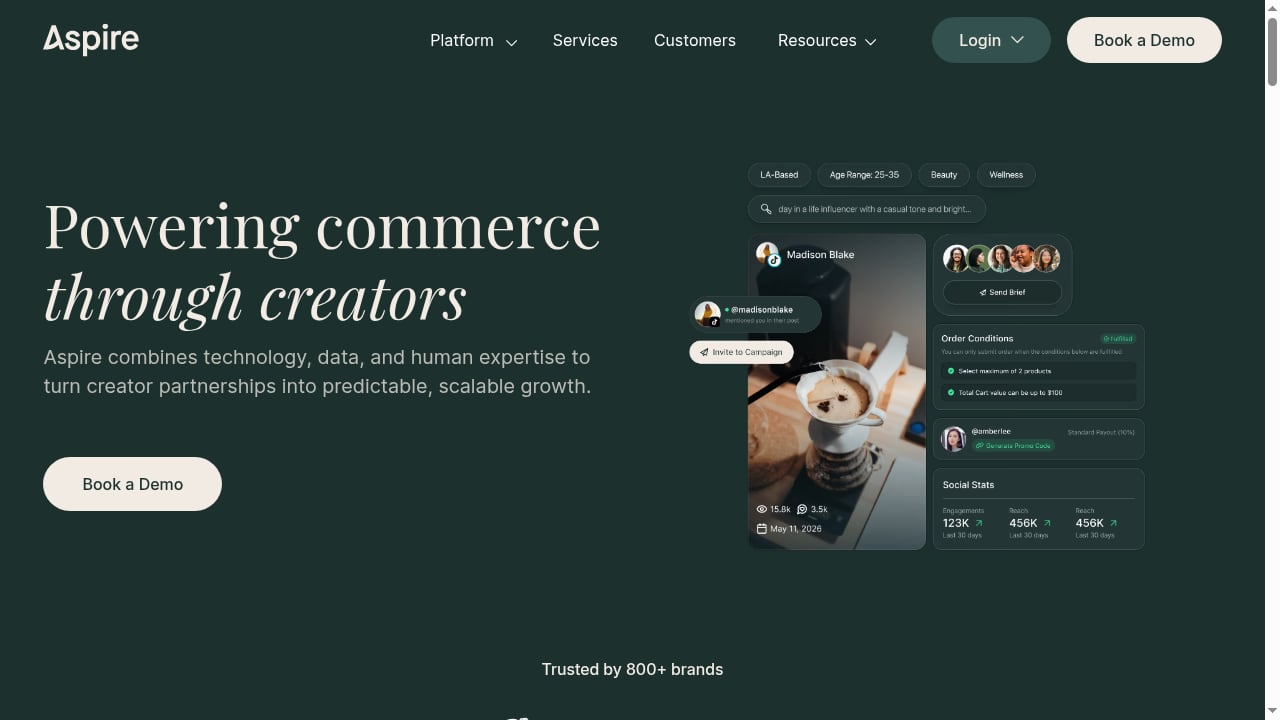
Aspire is an all-in-one influencer marketing platform built for e-commerce brands, combining technology, data, and human expertise. It is trusted by over 800 brands and offers the Aspire Marketplace, AI-powered creator discovery using plain language, a Contact Hub for centralized collaboration, personalized incentives with tailored agreements and commissions, a Campaign Manager for centralized tracking, content approval workflows, automated workflows with smart triggers, and analytics dashboards. Aspire also provides managed and agency services.
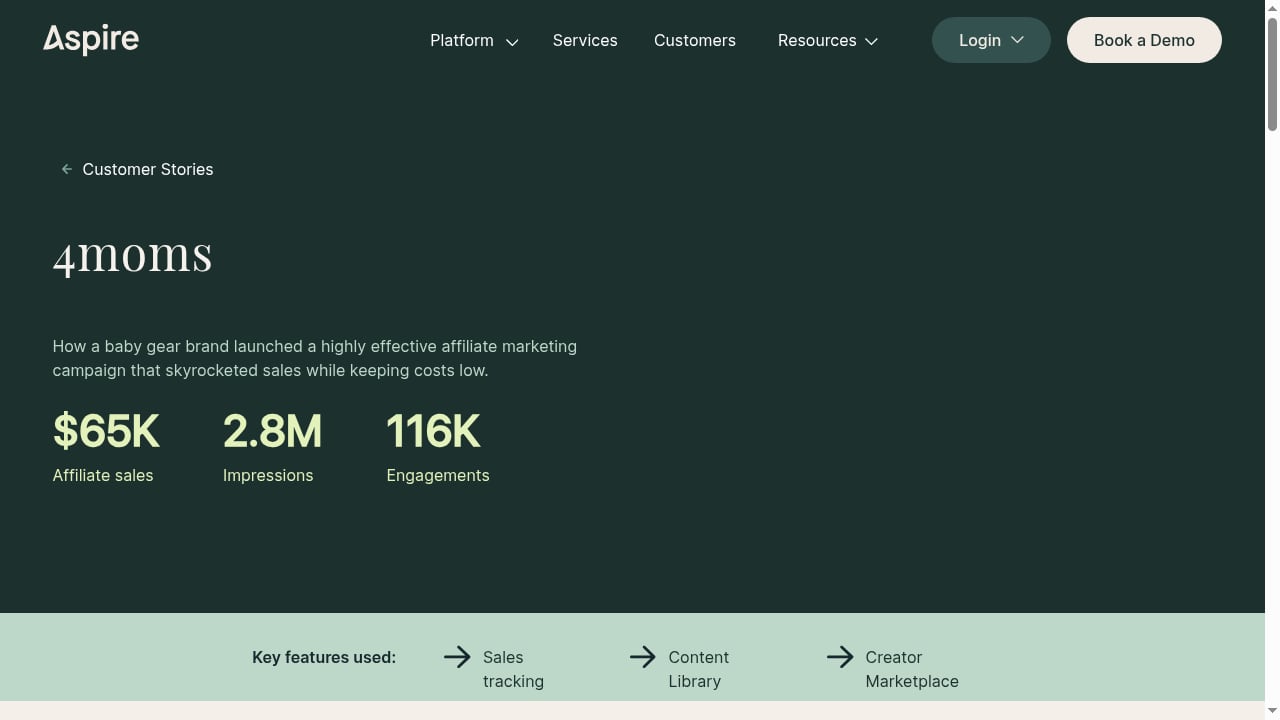
Why it ranks here: Aspire's proof points are concrete and commerce-focused. 4moms generated $65K in affiliate sales and 2.8M impressions; AN Skin drove over $1M in sales with 5.7k conversions; Aura Frames attributed 20% of total sales to influencer marketing. European Wax Center scaled to 100+ influencers with 150% ROI, and Outer boosted ROAS by 32% while growing affiliate sales 2,100%. Aspire has paid out $150M+ to creators since 2014.
Best for: E-commerce and DTC brands across home, food and beverage, beauty, fashion, fitness, baby, and automotive that want discovery, campaign management, and ROI measurement in one place.
5. Grin — Best for Brand-Owned Creator Programs
Grin is a creator management platform used by SKIMS, Rhode, and GoPro to scale brand-owned creator programs across 190M+ creators. Its agentic AI assistant, Gia, handles discovery, onboarding, partnerships, retention, reporting, and strategy optimization at scale.
Why it ranks here: Grin is built for the long-term ambassador model rather than one-off campaigns. True Citrus grew to 300 creators in one quarter with 1,200+ pieces of content and a 25% increase in creator response; Espin grew creator reach 250% and built 47 long-term partnerships.
Best for: E-commerce brands building always-on creator communities and ambassador programs.
6. Upfluence — Best for Affiliate-Led E-Commerce
Upfluence is an all-in-one affiliate and influencer marketing platform built for e-commerce and DTC, now infused with the Jaice AI campaign co-pilot. It indexes 12M+ creators across 7 networks and serves 1,300+ clients, turning existing customers into top-performing influencers through brand-affinity matching.
Why it ranks here: Upfluence blends influencer and affiliate workflows, which suits brands that pay creators on performance. Its customer-to-creator matching is a distinctive angle for brands with strong repeat-purchase bases.
Best for: DTC brands that want affiliate commissions and influencer campaigns managed together.
7. #paid — Best for Creator-Led Concept Pitches
#paid is an opt-in creator marketplace where 150,000+ vetted US and Canadian creators pitch concepts to brands, with algorithmic matching that hits 92% first-round approval. Brand-lift studies and a 30,000-respondent normative database back campaigns for McDonald's, Sephora, Coca-Cola, and Unilever.
Why it ranks here: The pitch model flips the usual discovery workflow — creators come to you with ideas — which can compress briefing cycles. Sephora Canada hit 96% reach with a Diwali creator campaign, and INFINITI lifted brand affinity by 19 points.
Best for: Brands that want creator-generated concepts and brand-lift measurement rather than top-down briefs.
8. Brandwatch — Best for Social Intelligence Plus Influence
Brandwatch is Cision's social suite combining consumer intelligence, social media management, and Influence (formerly Paladin), with Iris AI built on 17+ years of AI work. Influence tracks 65M+ creators with global payouts in 120+ currencies. Customers include Carlsberg, Toyota, BBC, and Henkel.
Why it ranks here: Brandwatch is the choice when influencer marketing must sit alongside listening and consumer intelligence. Insta360 managed 4,000 partners and cut costs dramatically, reporting 680M total views at $0.0004 cost per view.
Best for: Brands that want influencer programs connected to broader social listening and media intelligence.
9. Meltwater — Best for Media Intelligence Integration
Meltwater is a global media, social, and consumer intelligence platform whose influencer offering covers creator discovery, campaign management, and performance measurement on top of its monitoring data. It ingests 500M+ pieces of content a day from 270,000+ news sources and 15+ social channels, with Mira AI assisting across the workflow. Customers include Google, LVMH, AstraZeneca, and Danone.
Why it ranks here: Meltwater suits communications and PR teams that want influencer activity measured against earned media. TBWA identified trends 75% faster using its data analysis.
Best for: Communications-led teams that treat influencer marketing as part of an integrated media strategy.
10. Sprout Social Influencer Marketing — Best for Teams Already in Sprout
Sprout Social Influencer Marketing (built on the Tagger acquisition) puts creator discovery, campaign management, and influencer analytics inside the same platform a social team already uses for publishing, engagement, and listening. It sells to enterprise brands and agencies as a separate product from Sprout's base plans; reported pricing starts around $1,600 per month for the first seat, per public sources.
Why it ranks here: For teams already standardized on Sprout, adding influencer workflows avoids a second login and a second data silo. A native payments integration with Lumanu, announced in 2026, embeds payment and compliance infrastructure directly into the workflow.
Best for: Enterprise social teams that want influencer marketing inside their existing social management stack.
Quick Comparison: Which Platform Fits Your Program?
| If your priority is… | Start with… |
|---|---|
| Enterprise governance and multi-market scale | CreatorIQ, Traackr |
| E-commerce revenue attribution | Aspire, Grin, Upfluence |
| Social-first workflow integration | Later Influence, Sprout Social |
| Creator-led concept pitches | #paid |
| Social listening plus influence | Brandwatch, Meltwater |
Where Affiliate and Referral Software Fits
First viewport screenshot of www.aspire.io.
Influencer platforms increasingly overlap with affiliate and referral tools, but they are not the same category. If your program is SaaS-based and pays partners on recurring subscriptions rather than one-off content, a dedicated affiliate and referral system may be the better fit. PartnerShare, for example, helps SaaS teams run affiliate and referral programs with automated commission payouts and a promoter marketplace — a complementary workflow rather than a replacement for an influencer platform. For a fuller comparison of that adjacent category, see our top affiliate marketing software for SaaS ranking.
How to Evaluate an Influencer Platform Before You Buy
First viewport screenshot of www.aspire.io.
- Map your program type. Always-on ambassador programs need creator CRM depth; campaign bursts need fast discovery and approvals.
- Ask who moves the money. Determine who collects tax forms, who carries compliance liability, and where funds sit between funding and payout.
- Check commerce integrations. If you sell on Shopify or TikTok Shop, confirm native affiliate and commission support.
- Request attribution proof. Ask for case studies with revenue or ROAS figures, not just impressions.
- Test the AI claims. Demo plain-language discovery and automated workflows with your own briefs before signing.
Related reading
- How to Use PartnerShare with Journeybee: Setup & Workflow - Connect PartnerShare affiliate tracking with Journeybee PRM to run one partner program. Setup steps, workflows, examples, and the problems the pairing solves.
- PartnerShare vs impact.com vs Webgains: Which Fits SaaS? - Compare PartnerShare, impact.com, and Webgains for SaaS affiliate and referral programs. See strengths, pricing models, and best-fit use cases.
Sources and further reading
- Top Influencer Marketing Platforms 2026 | Performance-Based Rank | Influencer Strategists - Influencer Strategists scores 22 influencer marketing platforms on revenue, product depth and customer proof. Independent rankings, no paid placements.
- Best All-in-One Influencer Marketing Platforms in 2026 - Compare 11 all-in-one influencer marketing platforms by use case in 2026, including how each one handles creator payments, tax compliance, and your funds.
- Influencer Marketing Management Platform: 10 Picks for 2026 - Compare 10 top influencer marketing management platforms for 2026 - tools that handle creator CRM, outreach, payments, workflows, reporting, and brand safety.
Frequently Asked Questions
What is the best influencer marketing platform in 2026?
There is no single best platform. CreatorIQ leads for enterprise governance, Aspire leads for e-commerce ROI, and Later Influence leads for social-first commerce teams. The right choice depends on program size, channel mix, and payment requirements.
How much do influencer marketing platforms cost in 2026?
Enterprise platforms such as CreatorIQ and Traackr report contracts in the $25,000 to $55,000 per year range, per public sources. Mid-market and e-commerce platforms often price by creator volume or campaign scope, and many do not publish rates.
Do influencer marketing platforms handle creator payments?
Most do, but the model varies. Some run native payment modules, others use third-party rails such as PayPal, Airwallex, Tipalti, or Trolley, and some leave payments to your accounts payable team. Always confirm tax compliance and currency coverage.
What is the difference between an influencer marketing platform and affiliate software?
Influencer platforms manage creator discovery, campaigns, content rights, and reporting. Affiliate software manages performance-based partner programs, tracking, and commission payouts. Some platforms, like Upfluence, blend both; SaaS-focused tools like PartnerShare specialize in the affiliate and referral side.
Can I run influencer and affiliate programs together?
Yes. Many e-commerce brands use an influencer platform for content and ambassador programs and an affiliate system for commission-based partners. Confirm that tracking and attribution connect across both before committing.
Conclusion
The 2026 influencer marketing platform market rewards specificity. Enterprise programs with governance needs should shortlist CreatorIQ and Traackr; e-commerce brands focused on revenue attribution should look closely at Aspire, Grin, and Upfluence; and social-first teams already inside Later or Sprout Social have a natural path to adding influencer workflows. Start with your program type, confirm how money moves to creators, and demand attribution proof before you sign.
For adjacent decisions, our PartnerShare vs impact.com comparison covers the SaaS partnership platform side, and our Influence loyalty software review examines referral and loyalty tools for e-commerce.