Top 10 DTC Influencer, Affiliate & Referral Marketing Platforms 2026
Direct-to-consumer brands no longer run influencer, affiliate, and referral programs in separate silos. The strongest platforms in 2026 connect creator discovery, product seeding, tracked links, discount codes, commission payouts, and referral rewards into one measurable revenue system. This guide ranks ten platforms that genuinely serve that combined DTC workflow, explains how each was evaluated, and helps you match the right tool to your program maturity.
How we evaluated these platforms
First viewport screenshot of Case Studies.
We scored each product against eight criteria that matter to DTC teams running creator and referral programs at the same time:
- Creator and affiliate discovery: database size, audience quality signals, lookalike and customer-to-creator matching.
- Relationship management: creator CRM depth, outreach sequences, shared inboxes, and segmentation.
- Campaign workflow: briefs, approvals, product gifting, content collection, and usage rights.
- Attribution and tracking: link and code tracking, Shopify and ecommerce integrations, first-order and repeat-purchase visibility.
- Referral mechanics: reward structures, fraud controls, and referral intelligence.
- Payouts: multi-currency support, tax handling, and processing fee models.
- Pricing transparency: public pricing, demo requirements, and transaction fees.
- Scalability: enterprise governance, APIs, and multi-market support.
We prioritized products with verifiable feature evidence, public pricing signals where available, and a clear DTC use case rather than a generic feature list. Where a platform is better known for an adjacent category, we noted the limitation.
The top 10 DTC influencer, affiliate, and referral platforms for 2026
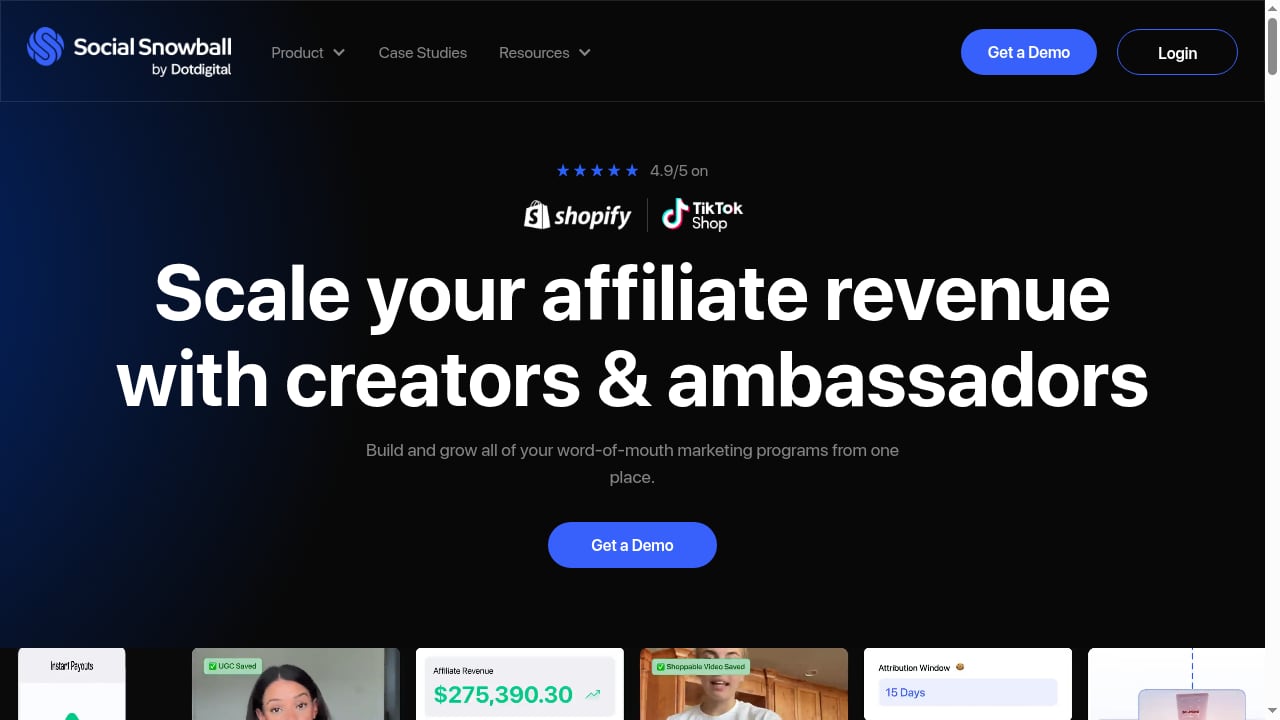
First viewport screenshot of Social Snowball | Influencer, Affiliate, & Referral Platform for DTC.
1. Social Snowball
Best for: DTC ecommerce brands that want creator partnerships and customer-to-affiliate conversion in one system.
Social Snowball is built specifically for the DTC model: it manages creator partnerships and turns existing customers into affiliates from the same dashboard. That combination matters because the most efficient DTC affiliate programs often start with buyers who already trust the brand, then expand into paid creator partnerships.
Strengths: unified creator and affiliate management, customer-to-affiliate recruitment, referral-friendly workflows, and a DTC-native design rather than a general affiliate network bolted onto a creator tool.
Considerations: it is a focused platform, so very large enterprises with complex multi-market governance may need to evaluate enterprise-grade alternatives alongside it.
2. impact.com
Best for: Mid-to-large brands that want affiliate, influencer, and referral partnerships under one performance dashboard.
impact.com unifies multiple partnership types, which is why it appears in both influencer and affiliate shortlists. For DTC teams, the appeal is a single attribution layer across creators, publishers, and referral partners. Pricing signals from third-party comparisons show a Starter tier from $30/month, Essentials from $500/month, and Pro from $2,500/month, with a 2.5% transaction fee across plans.
Strengths: broad partner-type coverage, enterprise reporting, and strong integration ecosystem.
Considerations: the transaction fee model and tiered pricing can become significant at scale. See our impact.com review for 2026 for a deeper breakdown.
3. Modash
Best for: In-house teams at Shopify brands that need end-to-end influencer and affiliate management.
Modash indexes a large public creator database and covers discovery, outreach, content tracking, affiliate tiers, and payouts. Its Shopify-native integrations connect creator activity directly to store revenue, and it supports both link and promo-code tracking. Public pricing starts at $199/month annual or $299/month monthly, with a free trial.
Strengths: visual AI search, customer-list matching to find existing brand fans, and processing fees only on payouts rather than a percentage of affiliate revenue.
Considerations: affiliate features are Shopify-centric, and channel coverage focuses on Instagram, TikTok, and YouTube.
4. Upfluence
Best for: Ecommerce brands and agencies running scalable influencer and affiliate campaigns across multiple storefronts.
Upfluence combines an AI co-pilot with a creator database and affiliate tracking across Shopify, WooCommerce, Magento, BigCommerce, Amazon, and Stripe. Its customer-to-creator discovery feature helps brands identify creators who are already customers, a useful starting point for affiliate recruitment.
Strengths: multi-platform commerce integrations, bulk creator payments in multiple currencies, and AI-assisted outreach.
Considerations: pricing is not public and third-party reports suggest real-world costs of $800–$3,000+ per month, with key integrations locked behind higher tiers.
5. Aspire
Best for: Ecommerce brands building long-term creator and ambassador relationships at scale.
Aspire emphasizes discovery, marketplace-driven recruitment, product seeding, and commerce-oriented workflows. It is frequently shortlisted for brands that treat creators as ongoing ambassadors rather than one-off campaign hires.
Strengths: strong relationship and gifting workflows, plus a creator marketplace model.
Considerations: no public pricing; third-party data suggests a median around $15,588 per year, so budget approval requires a sales conversation.
6. GRIN
Best for: Modern self-serve creator operations with ecommerce workflows.
GRIN differentiates through its creator CRM, ecommerce integrations, and an AI agent that supports program operations. It is a common choice for brands that want structured creator management without enterprise-level complexity.
Strengths: creator CRM depth, transparent pricing signals in 2026, and ecommerce workflow coverage.
Considerations: affiliate and referral depth may be lighter than platforms built primarily around performance partnerships.
7. Talkable
Best for: Mid-market and enterprise ecommerce brands that want referral as a performance channel with heavy testing and fraud control.
Talkable brings over a decade of fraud data to referral programs, with more than $110M prevented for clients according to the company. Its A/B testing suite covers offers, segments, and placements.
Strengths: mature fraud detection, dedicated customer success support, and optimization tooling.
Considerations: custom pricing plus an implementation fee; not designed for early-stage brands still testing product-market fit. For a side-by-side view, see PartnerShare vs PartnerStack vs Talkable.
8. Mention Me
Best for: Mid-market to enterprise brands that want referral intelligence benchmarked against real program data.
Mention Me positions referral as an intelligence layer, benchmarking client programs against a network of over 500 brands. Its Name Share mechanic captures organic referrals that many discount-code-only tools miss, and clients typically see 10–15% of new customers acquired via referral with CAC 30–50% lower than paid channels, according to the company.
Strengths: benchmark data, fraud and velocity controls, and enterprise compliance features.
Considerations: custom pricing and a mid-market-scale budget requirement.
9. Refersion
Best for: Ecommerce brands on Shopify or WooCommerce launching performance-based affiliate programs.
Refersion is a long-standing affiliate and referral platform for ecommerce. Public pricing signals include a Launch tier at $39/month plus 3% of affiliate sales, and a Growth tier at $199/month plus 2%.
Strengths: straightforward affiliate tracking, ecommerce integrations, and accessible entry pricing.
Considerations: creator discovery and influencer CRM features are less developed than dedicated influencer platforms, so it works best when you already have an affiliate audience.
10. Smile.io
Best for: Small to mid-market Shopify brands that want referral built into a loyalty program.
Smile.io includes referral as one earning action inside a broader loyalty system. It offers a free tier and paid plans from $15 to $999 per month, making it the fastest low-cost route to a live referral program on Shopify.
Strengths: fast setup, low entry cost, and loyalty-referral integration.
Considerations: limited creator discovery and affiliate management depth compared with the platforms ranked above.
How to choose: decision guidance by program stage
First viewport screenshot of Playbooks & Guides.
- Just starting with referrals: Smile.io or Refersion give you a live program quickly with low upfront cost.
- Running creator and affiliate programs together: Social Snowball, Modash, or Upfluence align creator management with affiliate tracking.
- Scaling referral as a performance channel: Talkable or Mention Me add fraud control and benchmark data.
- Unifying multiple partner types: impact.com consolidates affiliate, influencer, and referral partnerships.
- SaaS or non-ecommerce referral needs: a dedicated SaaS affiliate and referral platform may fit better than a DTC-native tool. PartnerShare, for example, serves SaaS teams and AI tool sites with promoter discovery and automated payouts, and our PartnerShare vs referral program software comparison covers that adjacent use case.
If your evaluation is expanding beyond DTC into broader partner ecosystems, our top 10 partnership management platforms for 2026 covers the enterprise end of that market.
Related reading
- How to Use PartnerShare with Voluum – Ad Tracker for Media Buyers - Connect PartnerShare with Voluum to track affiliate and media-buyer traffic in one place, cut discrepancies, and automate partner payouts.
Sources and further reading
- 10 Best Influencer Marketing Platforms in 2026: A Practical Buyer's ... - Introduction The best influencer marketing platforms have evolved far beyond searchable databases of Instagram and TikTok creators. Modern platforms can help brands discover creators, evaluate audience quality, manage outreach, coordinate briefs and approvals, distribute products, track affiliate re
- 9 Best Influencer Affiliate Platforms to Use in 2026 - A comparison of nine influencer affiliate platforms evaluated on workflow coverage, data quality, pricing, and real user feedback to help brands find the best fit for their creator affiliate programs.
- 10 Best Referral Marketing Software in 2026 - Best referral marketing software for 2026: compare 10 platforms on pricing, features, and fit, backed by data on what actually lowers CAC.
Frequently asked questions
What is a DTC influencer, affiliate, and referral marketing platform?
It is software that helps direct-to-consumer brands manage creator partnerships, affiliate tracking, and customer referral rewards in one connected workflow, usually with ecommerce integrations for attribution and payouts.
Do I need separate tools for influencer and affiliate programs?
Not necessarily. Platforms like Social Snowball, Modash, Upfluence, and impact.com combine creator management with affiliate tracking. Separate tools still make sense if one program is far more mature than the other.
How much do these platforms cost in 2026?
Entry points range from free or $15–$39 per month for lightweight referral tools to $199–$2,500+ per month for full influencer and affiliate platforms. Enterprise options like Aspire, Mention Me, and Talkable require custom quotes.
Which platform is best for Shopify brands?
Modash and Smile.io are the most Shopify-native options in this list, while Social Snowball and Refersion also support DTC ecommerce workflows well.
How important is fraud prevention in referral programs?
Very important once a program scales. Self-referrals, duplicate accounts, and coupon stacking are common. Talkable and Mention Me both invest heavily in fraud detection.
Conclusion
The best DTC influencer, affiliate, and referral platform for 2026 depends on where your program is today. If you are converting customers into affiliates, Social Snowball is purpose-built for that motion. If you need creator discovery plus affiliate tracking, Modash and Upfluence are strong contenders. If referral performance and fraud control are the priority, Talkable and Mention Me lead. And if you are consolidating multiple partner types, impact.com is the broadest option. Start with your program stage, not the longest feature list, and the shortlist becomes much clearer.