Top 10 Affiliate Marketing and E-commerce Platforms 2026
Choosing an affiliate platform in 2026 is less about picking the biggest name and more about matching the model to your business. A digital publisher selling courses needs a marketplace with instant approval and high commissions. A retail brand needs product feeds, coupon attribution, and return handling. A SaaS team needs recurring commissions and long cookie windows. The ten platforms below cover those models, and each entry includes the evidence behind its ranking.
How We Ranked These Platforms

First viewport screenshot of Resources | PartnerShare.
We evaluated each platform against six criteria, using publicly available program pages, network documentation, and published commission or payout terms:
- Category fit: Does the platform genuinely operate as an affiliate marketing or e-commerce platform, not just a referral add-on?
- Tracking and attribution: Cookie windows, server-side options, cross-device tracking, and how returns or refunds are handled.
- Payout mechanics: Frequency, thresholds, currencies, and whether merchants or networks control settlement.
- Recruitment and partner access: Whether the platform supplies affiliates, or whether you must bring your own.
- Pricing transparency: Published fees, revenue shares, or subscription tiers versus quote-only pricing.
- Ecosystem depth: Integrations with e-commerce stacks, APIs, and reporting that supports real optimization.
Where public terms vary by region or partner tier, we noted that instead of presenting a single number as universal.
The Top 10 Affiliate Marketing and E-commerce Platforms for 2026
ClickBank product interface.
1. ClickBank
ClickBank is the clearest example of a marketplace model done at scale. It connects digital product sellers with affiliates and handles both the storefront and the affiliate management layer. Public figures cited by the company include more than $7.3 billion in commissions paid and roughly 100,000 active affiliates, which matters because marketplace liquidity is the main reason to join one.
Best for: Digital products, health and wellness offers, and performance marketers who want instant affiliate approval and weekly or bi-weekly payouts. Commission structures commonly range from 50% to 75% on digital offers, with a 60-day cookie window reported in third-party comparisons. Sellers get affiliate recruitment, tracking, and payment processing without building their own network.
Watch-outs: The catalog skews toward digital and direct-response offers, so physical-goods retailers may find better product-feed support elsewhere.
2. Awin (including ShareASale)
Awin operates one of the largest global affiliate networks and absorbed ShareASale, giving advertisers access to a broad publisher base across retail, travel, and finance. It is a network rather than a standalone tool, so brands join the network and then recruit or approve publishers individually.
Best for: Mid-size to enterprise retailers that need international reach and a wide publisher mix. Awin is frequently cited as beginner-friendly on the publisher side, though some regions require a small deposit. Payouts are typically bi-monthly.
Watch-outs: Commission and cookie terms vary by advertiser, so the network itself does not guarantee consistent terms across programs.
3. Impact
Impact positions itself as a partnership automation platform rather than a classic affiliate network. It supports affiliates, influencers, B2B partners, and traditional publishers in one interface, with flexible payout scheduling and strong contract and tracking tooling.
Best for: Large enterprises and SaaS companies running multiple partner types at once. Impact is commonly used by brands that need custom attribution windows and automated payment flows rather than a fixed network standard.
Watch-outs: Pricing is typically quote-based, which makes it harder for small merchants to estimate costs before a sales conversation.
4. CJ Affiliate
CJ Affiliate (Commission Junction) is one of the oldest networks and still hosts many premium global brands. Approval is generally stricter than on open marketplaces, which raises publisher quality but slows onboarding.
Best for: Established publishers and brands that want access to well-known retail and travel advertisers. Commission rates vary widely, often cited in the 5% to 30% range depending on the advertiser.
Watch-outs: The strict vetting process can be a barrier for new affiliates without a track record.
5. Rakuten Advertising
Rakuten Advertising combines a global affiliate network with display and retargeting capabilities. It is often used by consumer brands that want affiliate activity measured alongside broader media.
Best for: Retailers and publishers focused on cash-conscious consumer categories. Average commissions are commonly reported around 5%, with terms set per advertiser.
Watch-outs: Like other large networks, terms and tracking windows are advertiser-specific, so due diligence per program is required.
6. Refersion
Refersion is an affiliate and influencer management platform built for merchants who want to run their own program rather than join a network. It handles affiliate signup, tracking, commission calculation, and payments, and integrates with major e-commerce platforms.
Best for: Shopify and similar store owners who want direct control over affiliate recruitment and branding. It is a good fit when the goal is an owned program with custom commission rules.
Watch-outs: You bring your own affiliates. Refersion does not supply a large marketplace of promoters the way ClickBank does.
7. Shopify Affiliate Program
Shopify's own affiliate program is a useful reference point for B2B and e-commerce-adjacent promotion. Public terms cited by Shopify allow affiliates to earn up to $150 USD for a qualified full-priced merchant referral, with a 30-day tracking window and a longer internal window from trial to paid conversion.
Best for: Creators and agencies whose audience includes merchants, store operators, or people starting an online business. It demonstrates how a complex product needs tracking that follows a longer decision path.
Watch-outs: It is a single-brand program, not a platform for running your own affiliate network.
8. HubSpot Affiliate Program
HubSpot is a strong example of a SaaS affiliate program with recurring commissions. Public terms list 30% monthly recurring commission for up to one year and a 180-day cookie window.
Best for: B2B publishers, consultants, and reviewers whose audience evaluates CRM and marketing software. The long cookie window reflects a longer sales cycle.
Watch-outs: Approval is application-based, and the program rewards education-heavy content over quick transactional pages.
9. Semrush Affiliate Program
Semrush publishes some of the most specific affiliate terms in the SaaS space, with up to $450 per sale and $10 per trial activation depending on product and partner tier, a 120-day cookie window, and last-click attribution.
Best for: SEO and marketing publishers with high-intent audiences. The program shows that audience quality can matter more than raw reach.
Watch-outs: Approval is strict, and some tiers require meaningful monthly traffic, which excludes brand-new sites.
10. Digistore24
Digistore24 is a marketplace focused on digital products, with instant approval and unusually frequent payouts. Public comparisons list commissions from 15% to 90% (often averaging 50% to 85%), a 180-day cookie window, and payouts up to four times per month.
Best for: Affiliates promoting digital products in health, finance, and self-development categories, and sellers who want a marketplace alternative to ClickBank.
Watch-outs: The catalog is concentrated in direct-response niches, so it is a poor fit for physical retail.
Platform vs. Network vs. Software: Which Model Do You Need?
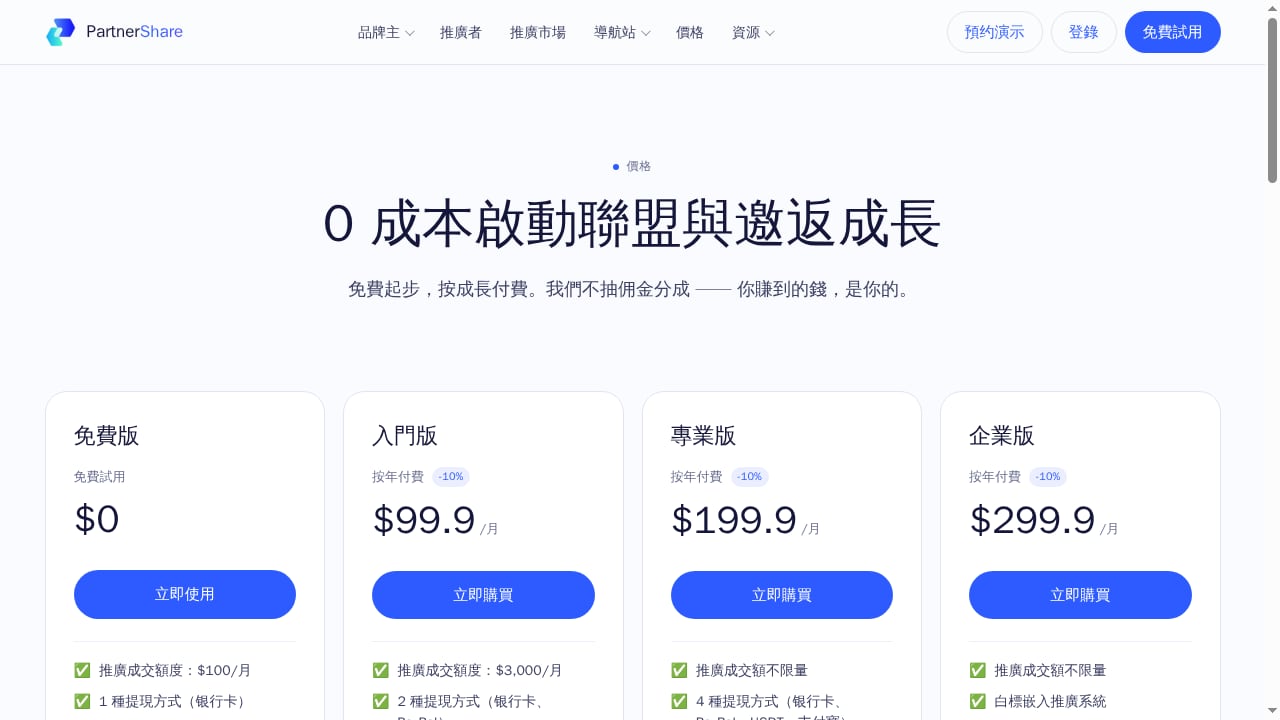
First viewport screenshot of Pricing | PartnerShare.
The ten platforms above fall into three operating models, and mixing them up is the most common sourcing mistake.
- Marketplaces like ClickBank and Digistore24 supply both products and affiliates. You join and start promoting or selling quickly.
- Networks like Awin, Impact, CJ Affiliate, and Rakuten Advertising supply publisher reach but leave program terms to each advertiser.
- Software like Refersion lets you run an owned program with your own rules, but you recruit your own partners.
If you are running a SaaS or e-commerce brand and want an owned program without marketplace dependence, the same decision logic applies to adjacent tools. A platform such as PartnerShare fits that adjacent workflow: it handles promoter recruitment, referral links, conversion tracking, and automated payouts for teams that want to run their own affiliate and referral programs rather than join a network. It is not part of this ranked list because it is a SaaS referral and affiliate management tool, not a marketplace or network. For a direct comparison of owned-program options, see our Referral Program Software Review 2026 and the PartnerShare vs Extole vs Webgains comparison.
How to Choose in 2026
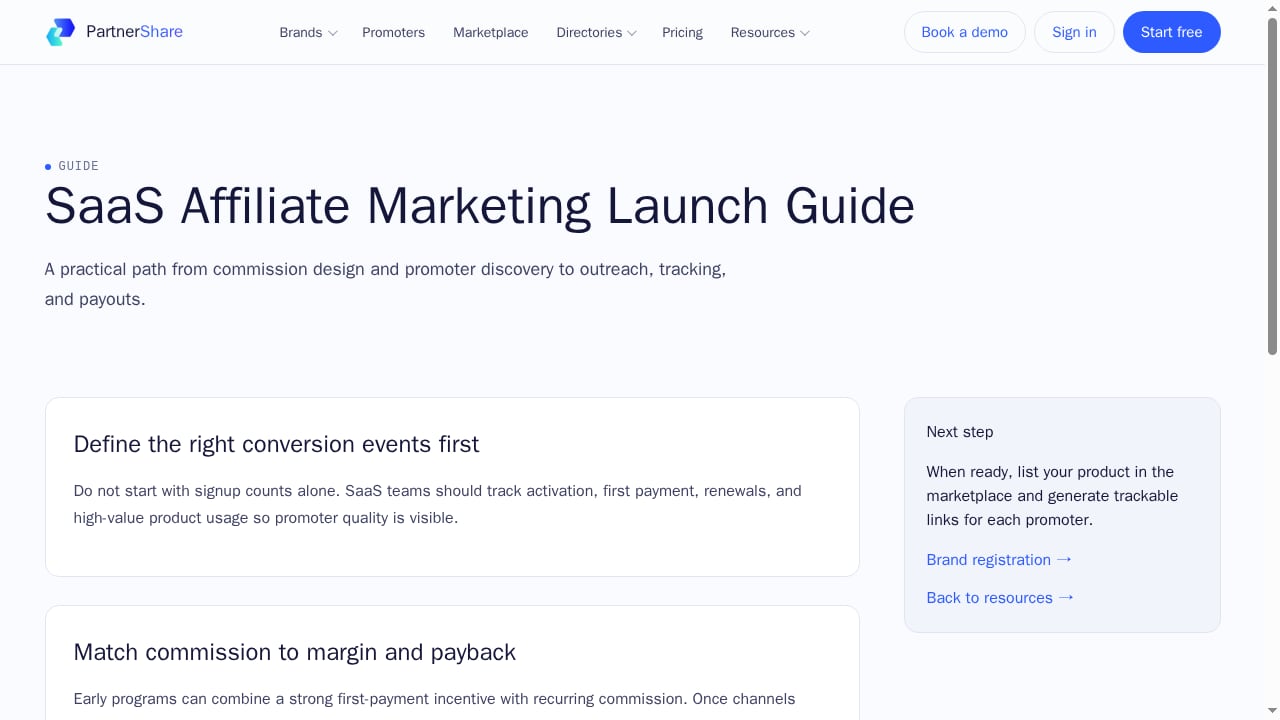
First viewport screenshot of SaaS Affiliate Marketing Launch Guide | PartnerShare.
Use these questions to narrow the list quickly:
- Do you need affiliates supplied, or do you already have them? Marketplaces supply demand; software does not.
- What is your sales cycle? A 24-hour cookie suits impulse retail; a 120- to 180-day window suits SaaS and high-ticket offers.
- How important is payout speed? If cash flow is tight, prioritize programs with weekly or multiple-monthly payouts over monthly net terms.
- Does the platform handle returns and refunds? Physical-goods merchants need reversal logic, not just click tracking.
- What does pricing actually look like? Networks often take a revenue share; software usually charges a subscription. Quote-only pricing should trigger extra diligence.
For a deeper look at the tracking layer specifically, our Top 10 Affiliate Marketing Tracking Software Products 2026 breaks down accuracy and integration differences.
Related reading
- PartnerShare vs Webgains: Affiliate Platform or Network? - Compare PartnerShare and Webgains: promoter recruitment, referral tracking, automated payouts, pricing transparency, and which model fits SaaS, ecommerce, or retail.
- Tradedoubler Review 2026: European Affiliate Network Fit - Evidence-based Tradedoubler review: ideal users, Grow SaaS pricing signals, strengths, limits, setup, and how it compares to other affiliate networks.
Sources and further reading
- Yotpo, Omnisend, Triple Whale And Other Affiliate Programs - Looking for ecommerce solutions to recommend and earn a commission? Look no further - our curated list gives you the top apps every brand uses to grow in 2026.
- 27 Best Affiliate Programs in 2026 (Ranked by Someone Who's Actually Used Them) - This article ranks 27 affiliate programs for 2026 and explains how affiliates should choose the right program based on their audience, commission rates,...
- Best Affiliate Marketing Programs in 2026 | BrandChamp - Explore the best affiliate marketing programs to model, with lessons on rewards, structure, tracking, and partner fit.
FAQ
What is the difference between an affiliate network and an affiliate platform?
A network aggregates advertisers and publishers and sets the relationship rules. A platform is the software used to run a program, whether or not a network is involved. ClickBank and Awin are networks; Refersion is software.
Which affiliate platform pays the fastest in 2026?
Based on published terms, Digistore24 stands out with payouts up to four times per month, and ClickBank commonly pays weekly or bi-weekly. Most large networks pay monthly or bi-monthly.
Are long cookie windows always better?
Not automatically. A 180-day window helps when the buying cycle is long, as with HubSpot or Digistore24. For low-cost impulse purchases, a shorter window with higher volume can perform just as well.
Can I run an affiliate program without joining a network?
Yes. Merchant-focused software such as Refersion, and SaaS-oriented tools like PartnerShare, let brands recruit and manage their own promoters. The trade-off is that you supply the affiliate demand yourself.
Which platform is best for a Shopify store?
Refersion is the most commonly cited fit for Shopify merchants who want an owned program. If you also want marketplace exposure, you can run Refersion alongside a network membership.
Conclusion
There is no single best affiliate marketing and e-commerce platform in 2026, only the best fit for your model. Marketplaces like ClickBank and Digistore24 win on liquidity and payout speed. Networks like Awin, Impact, CJ Affiliate, and Rakuten Advertising win on publisher reach. Software like Refersion wins on control. Match the model to your sales cycle, cash-flow needs, and whether you can supply your own affiliates, and the ranking above becomes a shortlist rather than a directory.