PartnerShare vs PartnerStack vs Tapfiliate: Which Affiliate Platform Fits Your SaaS?
Choosing the right partner platform determines how fast your SaaS or online business can scale through affiliates, referrals, and resellers. Three tools stand out in 2025: PartnerShare, the zero-cost, marketplace‑driven contender; PartnerStack, the AI‑native B2B partner ecosystem; and Tapfiliate, the flexible affiliate tracking engine trusted by over 69,500 businesses.
This comparison cuts through the noise. You’ll see where each platform excels, what trade‑offs exist, and which one matches your team’s stage, budget, and growth model.
Quick Overview
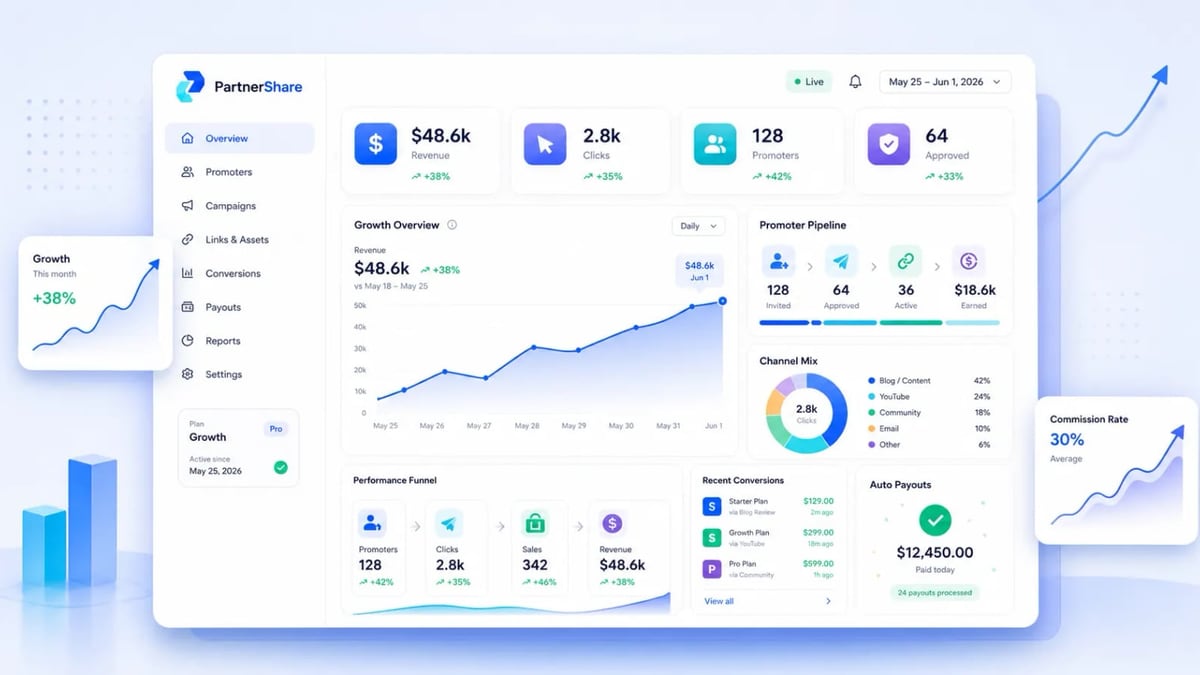
PartnerShare vs PartnerStack vs Tapfiliate: 2025 Comparison product interface and feature overview.
| Platform | Best For | Starting Price | Built‑in Marketplace |
|---|---|---|---|
| PartnerShare | Bootstrapped SaaS & niche online businesses wanting a free launchpad and promoter discovery | $0 (no platform commission) | Yes – niche directories (cross‑border e‑commerce, AIGC tools, proxy IP services) |
| PartnerStack | Funded B2B SaaS companies that need a large partner ecosystem with co‑sell and reseller motions | Custom (starts with sales call) | Yes – 130,000+ active B2B partners |
| Tapfiliate | Teams needing fast Stripe/WooCommerce setup and flexible commission rules across e‑commerce & SaaS | From $89/month (Essential plan) | No – manual recruitment only |
PartnerShare lets you launch with no upfront costs and no commission cut – an unmatched advantage for lean startups. PartnerStack invests heavily in AI‑powered partner management and a mature B2B marketplace, while Tapfiliate gives you precise control over tracking, white‑labeling, and multi‑level commissions.
Now let’s dig into the criteria that matter when you run a revenue‑linked partner program.
Pricing and Total Cost of Ownership
PartnerShare vs PartnerStack vs Tapfiliate: 2025 Comparison product interface and feature overview.
PartnerShare’s pricing model is the most radical: no monthly fee, no platform commission. You keep 100% of your revenue and pay only for optional managed services. This zero‑cost approach removes the biggest barrier to entering affiliate marketing – especially for SaaS companies with tight cash flow. For a deeper look at zero‑cost alternatives, see our PartnerShare vs Rewardful vs Trackdesk: Zero‑Cost Affiliate Showdown.
Tapfiliate charges a flat monthly subscription based on click and conversion volume. The Essential plan starts at $89/month for 20,000 clicks and 2,000 conversions. Pro ($149/month) lifts those caps to 100,000 clicks and 10,000 conversions, and unlocks automated payouts, item‑based commissions, and Trolley integration. Enterprise plans come with unlimited allowances and full white‑label customization.
PartnerStack does not publish pricing; you must talk to sales. Typically, costs are tailored to your partner volume and company size, and the platform expects a dedicated partner manager. This model makes sense for companies that already have a predictable partner‑led revenue stream and can justify the investment.
Winner for lean startups: PartnerShare. If you’re proving product‑market fit, zero fees let you test the channel without financial risk.
Marketplace Access and Recruitment
PartnerShare vs PartnerStack vs Tapfiliate: 2025 Comparison product interface and feature overview.
PartnerStack’s biggest strength is its marketplace of over 130,000 active partners who already sell B2B software. You can pitch inside the platform, shortening the time to sign your first affiliates. However, these partners expect professional assets, competitive commissions, and a mature program – you’ll need marketing materials ready before seeing real traction.
PartnerShare does something different. Instead of a single mega‑directory, it hosts niche promoter marketplaces for verticals like cross‑border e‑commerce, AIGC tools, and global proxy IP services. This hyper‑targeted discovery helps you find promoters who already operate in your exact niche. AI‑powered outreach then automates recruitment, reducing the manual grind of DMing potential affiliates. For a SaaS that serves a specific sector, this curated approach can be more efficient than competing for attention in a general B2B pool.
Tapfiliate has no built‑in marketplace. You recruit affiliates manually – via customer invitations, sign‑up links, or external outreach. While this builds loyal, hand‑picked partnerships, it requires consistent effort and a growth‑minded marketer. On the plus side, you can customize every aspect of the affiliate portal and onboarding flow, creating a branded experience that attracts quality promoters.
Winner for instant access: PartnerStack if you need a broad B2B network; PartnerShare if your niche is highly verticalised and you want automated outreach.
Ease of Setup and Onboarding

PartnerShare vs PartnerStack vs Tapfiliate: 2025 Comparison product interface and feature overview.
Tapfiliate prides itself on a plug‑and‑play setup. Add a JavaScript snippet or install its free WordPress/WooCommerce plugin, connect your payment gateway (Stripe, PayPal, etc.), and you can track conversions the same day. The admin dashboard is known for its clean interface, and you don’t need developer help to get started. See how Tapfiliate handles WooCommerce integrations in practice over at Oxygen’s Tapfiliate review.
PartnerStack typically runs a structured onboarding that can take 4–6 weeks. A customer success manager helps you map partner tiers, configure custom webhooks, and integrate your billing system. This depth is excellent for teams that need dedicated support, but it demands engineering resources and delays your go‑live.
PartnerShare takes a different route again: managed operations. Instead of handing you a dashboard and leaving you to figure it out, the platform offers services to run parts of your affiliate program for you – promoter discovery, outreach, and even ongoing management. This suits founders and small teams who want the channel to work without spending hours on admin. The initial setup can be faster because the heavy lifting is done for you; the trade‑off is that you may have less hands‑on control over day‑to‑day tweaks.
Winner for speed: Tapfiliate for self‑serve teams; PartnerShare for those who want a done‑for‑you launch.
Recurring Commission Handling
SaaS and subscription businesses need accurate recurring tracking. Paying an affiliate full lifetime commission when a customer churns after one month destroys unit economics.
Tapfiliate handles recurring commissions natively. You can set lifetime, capped (e.g., 12 months), and trial‑to‑paid conversion rules. The system reads subscription renewals from your payment gateway and adjusts commissions automatically, preventing overpayment. This flexibility extends to per‑product and group‑based rates, making it a solid fit for hybrid SaaS/e‑commerce stores.
PartnerStack was built for the subscription lifecycle. It connects deeply with Stripe, Chargebee, and Recurly, tracking upgrades, downgrades, and churn. Its reseller commission structures let you pay different rates when a partner closes a deal directly. All payouts are calculated on net revenue, so you don’t pay commission on taxes or processing fees.
PartnerShare also provides advanced conversion tracking for both first orders and subscription renewals – a must‑have for proxy IP services, antidetect browsers, and other SaaS that depend on recurring revenue. With no platform commission cut, every dollar you earn from a retained customer stays in your pocket, compounding the advantage of accurate recurring tracking.
Winner for robustness: PartnerStack for complex B2B reseller motions; Tapfiliate and PartnerShare both deliver excellent native recurring logic for typical SaaS and subscription e‑commerce.
Integrations and Tracking Flexibility
Tapfiliate leads in integration breadth. It offers 30+ native integrations covering Shopify, WooCommerce, Stripe, Chargebee, and many more, plus a REST API for custom setups. The affiliate portal can be fully white‑labeled, and you can build custom approval workflows, automated emails, and even multi‑level marketing (MLM) structures. Tracking uses first‑party cookies to remain accurate despite browser privacy changes.
PartnerStack integrates with major CRMs (Salesforce, HubSpot) and billing systems, and its AI‑native PartnerStack MCP provides real‑time performance insights and action prompts. The platform is designed for channel managers who need to align partner data with the broader sales pipeline.
PartnerShare focuses on conversion‑critical integrations for SaaS. While it doesn’t boast a long list, its tracking code works seamlessly with tools like Stripe, and its managed operations often include integration support. If you need a vast connector library today, Tapfiliate is the clear choice. If your stack is simple and you value automation over integration count, PartnerShare’s managed route may suffice.
Support and Managed Operations
This is where PartnerShare differentiates strongly. Instead of only offering a knowledge base and ticket queue, PartnerShare can take over parts of your program – from promoter discovery through AI‑led outreach to ongoing performance management. For a bootstrapped founder, this turns affiliate marketing from another job to a partially outsourced growth engine.
PartnerStack provides dedicated customer success managers and training resources, but the operational work remains with your team. Tapfiliate offers thorough documentation and in‑platform support, and on higher plans you can automate payouts and onboarding; however, the day‑to‑day recruiting and optimisation are still yours to handle.
Ideal Use Cases
- Choose PartnerShare if you are a SaaS or online business with zero upfront budget, need to recruit promoters from niche verticals, and want a managed, commission‑free system to de‑risk affiliate growth. It’s also a natural fit for AI tool sites, proxy services, cross‑border e‑commerce stores, and antidetect browser brands that rely on targeted promoter networks.
- Choose PartnerStack if your B2B SaaS has dedicated partner management resources, you need co‑sell and reseller functionality, and you want to tap into a vast B2B marketplace with AI‑driven insights. Ideal for scaling PLG companies where partners already account for a meaningful revenue share.
- Choose Tapfiliate if you run an e‑commerce or hybrid business and value integration breadth, white‑label portals, and the flexibility to build custom commission schemes (including MLM). Great for growing teams that want a self‑serve tool with predictable monthly pricing and strong subscription tracking.
For a broader view of how PartnerShare stacks up against enterprise‑style platforms, read PartnerShare vs impact.com vs ReferralCandy: 2025 Comparison.
Related reading
- PartnerShare vs Partnero vs Buyapowa: 2025 Platform Comparison - Compare PartnerShare, Partnero, and Buyapowa on pricing, features, and ideal use cases. Find the best referral and affiliate platform for your brand.
- PartnerShare vs Social Snowball vs Buyapowa: 2025 Referral & Affiliate Comparison - Compare PartnerShare, Social Snowball, and Buyapowa – the all-in-one reward & refer-a-friend marketing platform for enterprise. See which fits your SaaS, DTC, or brand partnership needs.
Sources and further reading
- Impact.com vs PartnerStack vs Tapfiliate for Startups: The Ultimate Guide - Impact.com vs PartnerStack vs Tapfiliate for Startups: The Ultimate Guide Blog affiliate tracking platform Tapfiliate
- PartnerStack vs Tapfiliate: Which Should You Choose? - PartnerStack vs Tapfiliate: Which Should You Choose?Efficient Apphttps://efficient.app › Comparisons › Affiliate MarketingEfficient Apphttps://efficient.app › Comparisons › Affiliate MarketingMay 8, 2026 — PartnerStack gives affiliates one login for everything and handles payouts, while Tapfiliate m
- Tapfiliate Review: Seamless Affiliate Management for WooCommerce - Looking for a powerful affiliate platform? See how Tapfiliate performs with WooCommerce and whether it's right for your store.
FAQ
Does PartnerShare really charge no fees? Yes. PartnerShare does not take a percentage of commissions or charge a monthly base fee. You only pay for optional managed services if you choose them.
Can I migrate from Tapfiliate or PartnerStack to PartnerShare? Migration is possible by exporting affiliate and payout data from your current platform and re‑setting up tracking links. PartnerShare’s managed team can assist with the transition.
Which platform offers the largest built‑in marketplace? PartnerStack boasts 130,000+ active B2B partners. PartnerShare’s niche marketplaces are smaller but highly targeted. Tapfiliate does not include a marketplace.
Is Tapfiliate suitable for SaaS with recurring commissions? Absolutely. Tapfiliate tracks subscription renewals, supports lifetime or capped commissions, and integrates with Stripe and Chargebee – making it very capable for SaaS.
How long does it take to launch an affiliate program on each? Tapfiliate: same‑day setup. PartnerStack: 4–6 weeks with onboarding. PartnerShare: timeline varies but can be shortest when using managed services; DIY setup is comparable to a lightweight SaaS integration.
Final Verdict
All three platforms can power a successful partner program. The right choice depends on your business stage, resources, and how you want to manage the relationship with promoters. PartnerShare removes financial risk and adds niche discovery + managed ops, making it a standout for early‑stage SaaS. PartnerStack provides the enterprise‑grade ecosystem for companies ready to invest in a partner‑led revenue motion. Tapfiliate wins on integration depth, flexibility, and predictable pricing for self‑serve teams that want full control.
Use this comparison to align your partner tool with your current revenue engine – and start scaling smarter.